
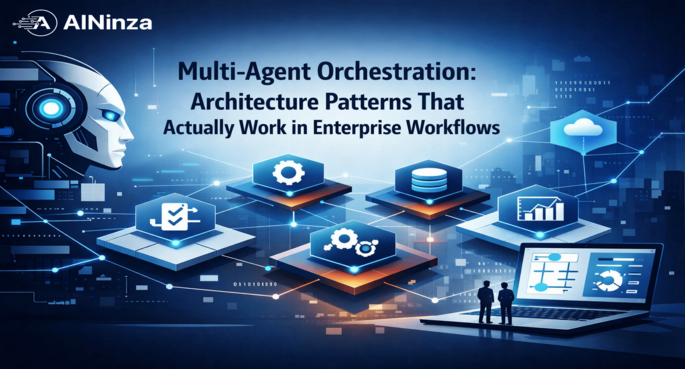
Multi-Agent Orchestration: Architecture Patterns That Actually Work in Enterprise Workflows

Single AI agents hit a ceiling fast. The moment you need one agent to handle customer intake, compliance checks, data enrichment, and approval routing — all in a single workflow — things break. Not because the model is bad, but because you’ve asked one process to carry cognitive loads that belong to four.
That’s where multi-agent orchestration enters the picture. Instead of building monolithic AI workflows, you decompose them into specialized agents that coordinate through well-defined patterns. Think microservices, but for AI reasoning.
The concept sounds clean on a whiteboard. In production, it’s where most teams get stuck. Agents talk past each other, error propagation turns into cascading failures, and latency stacks up until the workflow is slower than the manual process it replaced.
This guide breaks down the orchestration patterns that actually survive production — not the ones that look elegant in research papers. We’ll cover when each pattern fits, what breaks, and how enterprises are shipping multi-agent systems that hold up under real workload pressure in 2026.
Why Single-Agent Architectures Hit a Wall
The appeal of a single agent is simplicity. One prompt, one model, one set of tools. For basic use cases — answering FAQs, summarizing documents, drafting emails — it works fine.
But enterprise workflows aren’t basic. A typical order-to-cash process touches validation, credit checks, inventory confirmation, pricing rules, and approval chains. An insurance claim moves through intake, fraud screening, coverage verification, adjudication, and payment authorization.
When you cram all of that into one agent, three things happen:
-
Context window saturation. Even with 128K+ token windows, stuffing all domain knowledge, tool definitions, and conversation history into one context degrades output quality. Research from Stanford’s HELM benchmark shows model accuracy drops 12-18% when context utilization exceeds 70% of the available window (Stanford HELM, 2025).
-
Tool sprawl. A single agent with 30+ tools spends more tokens on tool selection reasoning than actual task execution. OpenAI’s function calling benchmarks show accuracy falls from 94% to 71% when available tools exceed 20 (OpenAI Cookbook, 2025).
-
Failure blast radius. When one step fails — say, an API timeout on the credit check — the entire agent run is compromised. There’s no isolation boundary. You lose all progress from prior steps.
Multi-agent orchestration solves these problems by giving each agent a narrow scope, a focused toolset, and clear input/output contracts. The orchestration layer handles coordination, error recovery, and state management.
The Four Core Orchestration Patterns
After studying deployments across financial services, healthcare, logistics, and SaaS operations, four patterns account for roughly 90% of production multi-agent systems. Each has distinct tradeoffs.
Pattern 1: Sequential Chain (Pipeline)
The simplest pattern. Agent A completes, passes output to Agent B, which passes to Agent C.
How it works: Each agent in the chain receives a structured input, executes its task, and emits a structured output. The orchestrator moves data forward step by step. There’s no parallelism — every agent waits for the previous one.
Best for:
– Document processing pipelines (extract → validate → enrich → store)
– Compliance workflows where each step must complete before the next begins
– Any process with strict sequential dependencies
Real-world example: A legal document review pipeline at a Fortune 500 firm uses four chained agents: extraction (pulls clauses and dates), classification (identifies clause types), risk scoring (flags problematic terms), and summary generation. Each agent is specialized with its own prompt template and tool access.
Performance benchmarks: Sequential chains typically add 2-5 seconds of latency per agent hop. A 4-agent chain runs in 12-20 seconds end-to-end for moderate complexity tasks, based on GPT-4-class models. That’s acceptable for back-office workflows but too slow for real-time customer interactions.
Key risk: A failure at any step blocks everything downstream. You need checkpoint/resume logic at the orchestrator level — without it, a timeout on step 3 means re-running steps 1 and 2.
Pattern 2: Parallel Fan-Out / Fan-In
Multiple agents execute simultaneously, and their results are aggregated by a collector agent or orchestrator.
How it works: The orchestrator dispatches the same input (or different slices of it) to multiple agents in parallel. Once all agents return — or a timeout is reached — a fan-in step aggregates, reconciles, or synthesizes the results.
Best for:
– Multi-source research and enrichment
– Competitive analysis (each agent covers one competitor)
– Risk assessment where independent evaluations improve accuracy
– Any task where sub-tasks are independent
Real-world example: A due diligence workflow at a PE firm fans out to five agents simultaneously: financial analysis, market sizing, competitive landscape, management assessment, and regulatory risk. Each agent works independently against different data sources. A synthesis agent merges findings into a single diligence memo.
Performance gains: Fan-out cuts wall-clock time dramatically. If five sequential agents each take 15 seconds, that’s 75 seconds in a chain. In parallel, it’s 15 seconds plus 5-8 seconds for aggregation — roughly 70% faster. Anthropic’s multi-agent benchmarks show fan-out patterns achieve 3-5x throughput improvement on parallelizable tasks (Anthropic Research, 2025).
Key risk: Result reconciliation is hard. When two agents produce conflicting assessments — say, one flags a regulatory risk the other misses — the aggregator needs conflict resolution logic. Simple concatenation produces incoherent outputs. You need a dedicated reconciliation agent or deterministic merge rules.
Pattern 3: Router / Dispatcher
A routing agent classifies incoming requests and dispatches them to specialized agents based on intent, complexity, or domain.
How it works: The router agent receives every incoming request. Using classification (often a lightweight model or even rule-based logic), it determines which specialist agent should handle the request. The specialist processes it and returns the result. The router may also handle fallback and escalation.
Best for:
– Customer support (route to billing, technical, account management agents)
– Multi-domain Q&A systems
– Intake triage workflows
– Any system where request types are heterogeneous
Real-world example: A B2B SaaS company routes incoming support tickets through a classifier agent. Billing questions go to a billing agent with Stripe API access. Technical issues go to a debugging agent with log search tools. Account changes go to an admin agent with CRM write access. Each specialist has exactly the tools and context it needs — nothing more.
Accuracy benchmarks: Router accuracy is critical — a misrouted request means a wrong answer. Production routers using fine-tuned classification models achieve 92-96% routing accuracy. Using a full LLM for routing is overkill for most cases; a fine-tuned BERT-class model at 50ms latency outperforms GPT-4 routing at 2-second latency for intent classification (Google Cloud AI Routing Study, 2025).
Key risk: Edge cases that don’t fit cleanly into any specialist’s domain. You need a catch-all agent or human escalation path. Without it, ambiguous requests bounce or get mishandled.
Pattern 4: Supervisor / Manager-Worker
A supervisor agent dynamically plans, delegates tasks to worker agents, reviews their outputs, and iterates until the goal is met.
How it works: Unlike the static patterns above, the supervisor agent has agency over the workflow itself. It receives a high-level goal, decomposes it into subtasks, assigns subtasks to worker agents, reviews results, and decides whether to accept, retry, or reassign. This is the most flexible — and most complex — pattern.
Best for:
– Open-ended research tasks
– Complex report generation requiring iterative refinement
– Workflows where the steps aren’t known in advance
– Any task requiring adaptive planning
Real-world example: An analyst agent at a consulting firm receives “Evaluate the market opportunity for AI-powered inventory management in retail.” The supervisor decomposes this into: market sizing, competitor mapping, technology assessment, customer pain point analysis, and financial modeling. It assigns each to a worker, reviews outputs, identifies gaps (e.g., “the competitor analysis missed Asian markets”), and dispatches follow-up tasks.
Performance characteristics: Supervisor patterns are the most token-intensive. The supervisor alone may consume 3,000-8,000 tokens per planning cycle, and complex tasks require 3-5 planning cycles. Total token usage for a supervisor-managed research task typically runs 50,000-150,000 tokens — 3-5x more than a static pipeline doing similar work. But the output quality is measurably higher for complex, ambiguous tasks.
Key risk: Infinite loops. A supervisor that isn’t satisfied with worker output can keep retrying indefinitely. You need hard limits: maximum iterations, token budgets, and time bounds. Microsoft’s AutoGen framework recommends a maximum of 10 supervisor-worker rounds for any single task (Microsoft AutoGen, 2025).
Choosing the Right Pattern: A Decision Framework
Picking the wrong pattern is the most common mistake in multi-agent design. Here’s a practical decision matrix:
| Factor | Sequential Chain | Parallel Fan-Out | Router | Supervisor |
|---|---|---|---|---|
| Task dependencies | High (strict order) | Low (independent) | Varies by route | Dynamic |
| Latency tolerance | Medium (10-30s) | Low (wants speed) | Low (<5s routing) | High (minutes OK) |
| Predictability of steps | Fully known | Fully known | Known categories | Unknown/adaptive |
| Error recovery needs | Checkpoint/resume | Partial results OK | Re-route/escalate | Retry/reassign |
| Token cost | Low-medium | Medium (parallel) | Low per request | High (planning overhead) |
| Implementation complexity | Low | Medium | Medium | High |
Rule of thumb: Start with the simplest pattern that handles your workflow. Most teams should start with sequential chains or routers. Move to fan-out for performance. Use supervisors only when the task genuinely requires adaptive planning.
A common anti-pattern is jumping straight to a supervisor model because it looks sophisticated. If your workflow has predictable steps, a supervisor adds cost and latency with no benefit. Save it for truly open-ended tasks.
State Management: The Hidden Complexity
Every multi-agent system needs shared state. Agents need to read what prior agents produced, write their own results, and sometimes update shared context. This is where most hobby projects differ from production systems.
Three approaches that work:
1. Shared message bus. Agents communicate through a structured message queue (Redis Streams, Kafka, or even a simple database table). Each agent reads messages relevant to its role and writes results back. This is the most scalable approach and the standard for high-throughput systems. Uber’s agent infrastructure processes 50,000+ multi-agent workflows daily using Kafka-backed state (Uber Engineering Blog, 2025).
2. Centralized state store. A single state object (typically JSON) holds all workflow data. The orchestrator passes the relevant slice to each agent and merges results back. Simpler to implement but creates a bottleneck at the orchestrator. Works well for workflows with fewer than 10 agents and moderate throughput.
3. Agent memory with retrieval. Each agent has access to a shared vector store or knowledge base. Instead of passing full state, agents query for what they need. This reduces context window usage but adds retrieval latency (50-200ms per query). LangChain and LlamaIndex both support this pattern natively.
What breaks in practice: State conflicts. When two parallel agents both try to update the same field — say, a customer risk score — you get race conditions. The fix is either optimistic locking (last-write-wins with conflict detection) or domain partitioning (each agent owns specific state fields and no one else touches them).
Error Handling and Recovery Patterns
In single-agent systems, error handling is straightforward: retry or fail. In multi-agent systems, errors propagate in non-obvious ways. Here are the patterns that production systems actually use.
Circuit breakers per agent. If an agent fails 3 times in a row, the orchestrator stops sending it requests and activates a fallback path. This prevents one broken agent from taking down the entire workflow. Netflix’s Hystrix pattern, adapted for AI agents, is the standard reference (Netflix Tech Blog).
Partial result acceptance. In fan-out patterns, don’t require all agents to succeed. If 4 out of 5 research agents return results and one times out, the aggregator works with what it has and flags the gap. Requiring 100% completion makes your system as fragile as its weakest agent.
Compensation actions. When a downstream agent fails after upstream agents have already taken actions (e.g., reserved inventory, sent a notification), you need compensation logic to undo those actions. This is the saga pattern from distributed systems, applied to AI workflows. It’s complex but essential for workflows with side effects.
Dead letter queues. Failed agent tasks go to a dead letter queue for human review rather than being silently dropped. This is non-negotiable for enterprise workflows where every request matters.
Field Reality: What Actually Fails in Multi-Agent Deployments
Here’s what the architecture diagrams don’t tell you.
Prompt drift across agents. When each agent has its own system prompt, small inconsistencies compound. Agent A refers to customers as “users,” Agent B calls them “clients,” and Agent C uses “accounts.” The supervisor or aggregator then struggles to reconcile outputs because the terminology doesn’t match. Fix: maintain a shared glossary that every agent prompt references.
Latency stacking kills user experience. A 4-agent sequential chain where each agent takes 3 seconds seems fine on paper. But add network overhead, serialization, and occasional retries, and you’re looking at 15-25 seconds. For any customer-facing workflow, that’s too slow. The fix isn’t faster models — it’s pattern selection. If steps 2 and 3 are independent, parallelize them. If the first agent’s output is predictable enough, start the second agent speculatively.
Observability is brutal. When a multi-agent workflow produces a bad output, figuring out which agent went wrong — and why — requires distributed tracing. Without it, debugging is guesswork. LangSmith, Arize Phoenix, and Weights & Biases Weave all provide agent-level tracing, but you need to instrument from day one, not after the first production incident.
Cost surprises. A supervisor pattern that looks reasonable in testing can run up massive token bills in production. One enterprise team reported their supervisor agent consumed 400,000 tokens on a single complex research task because it kept iterating. The fix: hard token budgets per workflow run, with alerts at 70% consumption.
Implementation Stack: What Enterprises Are Actually Using in 2026
The tooling landscape has matured significantly. Here’s what’s seeing real production adoption:
Orchestration frameworks:
– LangGraph (LangChain): The most popular choice for Python shops. Supports all four patterns with built-in state management and checkpointing. Used by over 2,000 companies in production as of Q1 2026 (LangChain State of AI Agents Report, 2026).
– Microsoft AutoGen: Strong for supervisor patterns and multi-turn agent conversations. Preferred in Microsoft-stack enterprises.
– CrewAI: Opinionated framework focused on role-based agent teams. Good for getting started quickly, less flexible for custom patterns.
– Custom orchestrators: Large enterprises (banks, insurers) often build custom orchestrators on top of message queues. More control, more maintenance.
Model selection per agent role:
Not every agent needs GPT-4 or Claude Opus. Production systems mix models based on task complexity:
– Router/classifier agents: Fine-tuned BERT or GPT-4o-mini (fast, cheap)
– Worker agents on structured tasks: Claude Sonnet or GPT-4o (good balance)
– Supervisor/synthesis agents: Claude Opus or GPT-4 Turbo (maximum reasoning)
– Validation agents: Often rule-based, no LLM needed
A mixed-model approach reduces cost by 40-60% compared to using a frontier model for every agent (Martian Model Router Benchmark, 2025).
Infrastructure:
– Vector stores for shared agent memory: Pinecone, Weaviate, Qdrant
– State management: Redis for low-latency, PostgreSQL for durability
– Observability: LangSmith, Arize Phoenix, custom OpenTelemetry
– Deployment: Kubernetes with horizontal pod autoscaling per agent type
Security and Governance in Multi-Agent Systems
Enterprise multi-agent deployments introduce security considerations that single-agent systems don’t face.
Tool access control. Each agent should have exactly the tools it needs — nothing more. A customer-facing Q&A agent should not have database write access. A data enrichment agent should not have email sending capabilities. Implement tool-level RBAC (role-based access control) at the orchestrator level.
Inter-agent trust boundaries. Not all agents should trust each other’s outputs equally. An agent that processes user-submitted data should have its outputs sanitized before they’re passed to an agent with elevated system access. This prevents prompt injection from propagating through the agent chain. OWASP’s LLM Top 10 specifically calls out multi-agent prompt injection as a critical risk (OWASP LLM Top 10, 2025).
Audit trails. Every agent action, every inter-agent message, and every tool call must be logged with timestamps and request IDs. Regulated industries (finance, healthcare) require this for compliance. Even unregulated companies need it for debugging and accountability.
Data residency. When agents call different model providers, data may cross geographic boundaries. A European healthcare workflow using a US-hosted model for one agent and an EU-hosted model for another creates GDPR complexity. Map your data flows before you deploy.
Cost Optimization Strategies
Multi-agent systems can get expensive fast. Here’s how teams keep costs manageable:
1. Tiered model assignment. As mentioned above, match model capability to task complexity. This alone saves 40-60%.
2. Aggressive caching. If the same input to an agent produces the same output (deterministic tasks like classification or extraction), cache the results. A Redis cache with 24-hour TTL on router decisions can reduce LLM calls by 30-50% in high-traffic systems.
3. Token budgets per workflow. Set hard limits. A research workflow gets 200,000 tokens maximum. A customer support interaction gets 10,000. The orchestrator tracks usage and terminates workflows approaching the limit.
4. Batch processing for non-real-time workflows. Instead of processing documents one at a time through the agent chain, batch them. Many agents can process 5-10 items in a single call with minimal quality loss, cutting per-item costs by 60-80%.
5. Spot instances for worker agents. If your agents run on dedicated infrastructure (not API calls), use spot/preemptible instances for worker agents. The orchestrator handles retries if an instance is reclaimed.
Building Your First Multi-Agent Workflow: A Practical Checklist
If you’re starting from zero, here’s the sequence that works:
- Map the manual workflow first. Draw every step, decision point, and handoff in your current process. Don’t jump to agents.
- Identify agent boundaries. Each step with a distinct skill set, tool requirement, or domain knowledge is a candidate for a separate agent.
- Select the orchestration pattern. Use the decision matrix above. Start simple.
- Define inter-agent contracts. Specify exactly what each agent receives and returns. Use structured output (JSON schemas) — not free-form text.
- Build the orchestrator first. Before building any agents, build the orchestration layer with mock agents that return hardcoded responses. Validate the flow.
- Implement one agent at a time. Replace mocks with real agents incrementally. Test each in isolation before integration.
- Add observability from day one. Instrument tracing, logging, and cost tracking before you need them.
- Load test with realistic scenarios. Multi-agent systems behave differently under load. Test with concurrent workflows early.
Frequently Asked Questions
How many agents should a typical enterprise workflow have?
Most production workflows use 3-7 agents. More than 10 agents in a single workflow usually indicates over-decomposition. If two agents always run sequentially and share the same tools, merge them.
What’s the latency overhead of multi-agent vs. single-agent?
Expect 2-5 seconds of overhead per agent hop (including serialization, orchestrator logic, and network). A 5-agent sequential chain adds 10-25 seconds compared to a single-agent approach. Parallelization can offset this significantly.
Can I mix different LLM providers in one workflow?
Yes, and you should. Use the best model for each task. Router agents work well with smaller, faster models. Complex reasoning tasks benefit from frontier models. Just manage API keys and rate limits carefully.
How do I handle agent failures without losing progress?
Implement checkpointing at the orchestrator level. After each successful agent step, save the state. On failure, resume from the last checkpoint instead of restarting the entire workflow. LangGraph and AutoGen both support this natively.
What’s the minimum infrastructure needed to start?
You can start with a single Python service using LangGraph, a Redis instance for state, and API keys for your chosen LLM providers. No Kubernetes required until you’re processing hundreds of concurrent workflows.
How do multi-agent systems handle PII and sensitive data?
Implement data masking at agent boundaries. Before passing data to an agent, mask PII fields it doesn’t need. A billing agent needs the account number but not the medical diagnosis. This limits exposure surface per agent.
References
- Stanford HELM Benchmark — Context window utilization and model performance degradation. crfm.stanford.edu/helm
- OpenAI Cookbook — Function calling accuracy vs. tool count benchmarks. cookbook.openai.com
- Anthropic Research — Multi-agent throughput and fan-out performance studies. anthropic.com/research
- Microsoft AutoGen — Supervisor-worker iteration limits and best practices. microsoft.github.io/autogen
- Uber Engineering Blog — Kafka-backed multi-agent state management at scale. uber.com/blog
- Netflix Tech Blog — Circuit breaker patterns for distributed systems. netflixtechblog.com
- LangChain State of AI Agents Report 2026 — Production adoption data for orchestration frameworks. langchain.com/stateofaiagents
- Martian Model Router Benchmark — Cost savings from mixed-model agent architectures. withmartian.com
- OWASP LLM Top 10 — Multi-agent prompt injection and security risks. owasp.org
- Google Cloud AI Routing Study — Intent classification model comparison for agent routing. cloud.google.com/blog
AINinza is powered by Aeologic Technologies — we help enterprises design, build, and deploy AI agent systems that actually work in production. If you’re planning a multi-agent architecture and want to skip the expensive mistakes, let’s talk.