
AI Agent Vendor Selection in 2026: The Enterprise Buyer’s Due Diligence Playbook

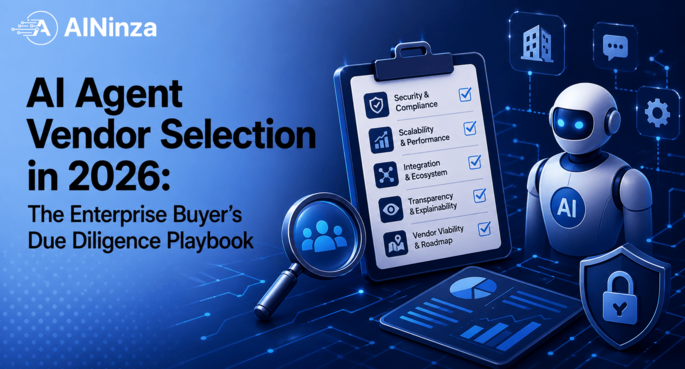
Buying an AI agent platform in 2026 is not the same as buying SaaS in 2018. The demos are slicker, the promises are louder, and the pricing is often just vague enough to get expensive after procurement signs the paperwork.
That is the trap.
Most enterprise buyers do not fail because they picked a “bad AI vendor.” They fail because they bought before defining where the agent will touch systems, who owns accuracy, what latency is acceptable, how costs scale under real usage, and what happens when the model is confidently wrong.
The market has moved fast. IBM’s 2025 CEO study found that 61% of surveyed CEOs are already adopting AI agents today or preparing to implement them at scale, yet only 25% of AI initiatives delivered expected ROI and only 16% scaled enterprise-wide. That gap is the real signal. Adoption is no longer the hard part. Buying well is.
This guide is for teams that are already serious. You are not asking whether AI agents matter. You are asking which vendor can survive security review, integrate with your stack, prove value in 90 days, and not blow up your budget six months later.
The short version: do not buy the smartest demo. Buy the vendor with the clearest path to controlled production value.
Why AI Agent Procurement Is Harder Than Traditional Software Procurement
Traditional enterprise software mainly asked three questions: does it solve the workflow, can it integrate, and what is the contract value? AI agent buying adds a more chaotic layer:
- output quality is probabilistic, not deterministic
- model costs can vary with prompt size, concurrency, and tool usage
- security risk extends into prompts, retrieved data, model responses, and third-party model providers
- operational ownership is split across IT, security, business teams, data teams, and legal
- a pilot that looks amazing with a curated dataset can collapse under production variance
AWS called this out directly in its 2025 prescriptive guidance for enterprise-ready generative AI platforms: the hard problems are not just infrastructure, but security, compliance, responsible AI, integration, IP protection, and ROI measurement.
That means procurement cannot be reduced to feature comparison. It has to become due diligence across architecture, economics, governance, and operating fit.
Start With the Business Case, Not the Model
If the buyer cannot answer “what does success look like in 90 days,” the vendor conversation is already sloppy.
Start with one tightly defined value path:
- reduce average handling time in support by 20% to 35%
- cut manual research time for sales or operations by 30% to 50%
- increase first-response coverage without increasing headcount
- shorten turnaround time on repetitive internal workflows by 25%+
- improve document processing throughput with human review only on exception cases
The right unit of evaluation is not “which model sounds smartest.” It is:
- workflow impact
- process risk
- integration friction
- time to measurable ROI
- cost to scale
Deloitte’s 2025 AI economics perspective makes the point cleanly: AI costs are becoming nonlinear and token-driven, not just seat-based or infrastructure-based. If your business case is fuzzy, token-based spend drift will punish you quietly.
A strong procurement brief should define:
- target workflow
- current baseline metrics
- expected improvement range
- maximum acceptable error or escalation rate
- systems involved
- compliance constraints
- pilot timeline
- budget guardrails
Without this, you are not evaluating vendors. You are shopping while distracted.
The 7-Dimension AI Agent Vendor Scorecard
A good scorecard does two things: it slows down hype, and it makes tradeoffs visible. Here is the 7-dimension framework I would actually use.
1. Business Fit
Evaluate whether the vendor maps to the exact use case you want live first.
Questions:
– Do they already support your workflow category out of the box?
– Can they show production examples in your function or industry?
– Is there a credible path from pilot to scaled deployment?
– Can the team explain failure boundaries, not just success stories?
Scoring lens:
– 5/5: proven use case fit, clear ROI logic, strong references
– 3/5: adjacent capability, but meaningful customization required
– 1/5: generic platform with thin workflow proof
2. Integration Depth
This matters more than the demo, because enterprise value usually sits behind CRM, ERP, ticketing, document systems, knowledge bases, or internal APIs.
Questions:
– Native integrations or custom connectors?
– API quality and webhook support?
– Role-based access and environment separation?
– Can the agent read, write, or only recommend?
– How are retries, approvals, and fallback paths handled?
If the vendor cannot explain how the agent behaves around system failures, rate limits, permissions, and human approval gates, you are looking at a demo layer, not an enterprise platform.
3. Security and Governance
This is where weak vendors start sweating.
NIST’s AI RMF and Google’s SAIF both reinforce the same core point: securing AI systems is not just about perimeter security. You need controls for model access, prompt misuse, data exfiltration, poisoning risk, logging, policy enforcement, and incident response.
Questions:
– What data is sent to which underlying model provider?
– Are prompts, outputs, and retrieved context logged?
– Can logs be retained in-region or exported to SIEM tools?
– Are there controls for prompt injection, jailbreaks, and data leakage?
– Is customer data used for model training?
– What identity, access, and approval controls exist?
– How is model/version change management handled?
– Is there an audit trail for agent actions?
Minimum non-negotiables:
– SSO / SAML support
– RBAC
– audit logs
– encryption in transit and at rest
– documented data retention policy
– model/provider disclosure
– approval checkpoints for write actions
4. Reliability and Evaluation Discipline
Elastic’s RAG evaluation guidance is useful here because it highlights a brutal truth: raw demo quality means very little without repeatable evaluation. Enterprises need measurable relevance, consistency, and hallucination controls.
Questions:
– How does the vendor evaluate answer quality?
– Do they benchmark retrieval relevance separately from generation quality?
– Can they show task-specific acceptance thresholds?
– What happens when confidence is low?
– Are there guardrails for no-answer, escalation, or human review?
You want to hear words like:
– eval sets
– regression tests
– grounding checks
– fallback routing
– confidence thresholds
– approval loops
If you only hear “our model is very accurate,” run.
5. Economics and Pricing Transparency
This is the section procurement and finance should own aggressively.
NVIDIA’s 2025 inference benchmarking guidance pushed enterprises toward cost-per-token and throughput/latency-based sizing, while Deloitte noted some firms are already seeing AI consume 25% to 50% of IT spend categories. Translation: hidden economics will wreck a deal faster than feature gaps.
Questions:
– Is pricing seat-based, task-based, token-based, or hybrid?
– What drives overages?
– What is the cost curve at 10x usage?
– Are orchestration, retrieval, and model calls all included?
– Are premium models optional or default?
– What implementation services are required?
– What internal staffing will you still need?
Ask vendors for three scenarios:
– pilot volume
– expected 12-month production volume
– stress-case volume
Then compare effective cost per resolved workflow, not just annual contract value.
6. Deployment and Time-to-Value
The faster a vendor reaches controlled production value, the more forgiving buyers can be on polish.
Questions:
– How long to production for one high-value use case?
– What dependencies block launch?
– What customer-side work is required from IT, data, legal, and business teams?
– Are there reusable templates and implementation playbooks?
– What does the first 30/60/90 days actually look like?
As a rule, if the vendor cannot map a realistic first 90 days, they probably have not done enough real deployments.
7. Vendor Maturity and Strategic Risk
Plenty of AI startups can ship a killer proof of concept. Fewer can survive procurement, support enterprise uptime expectations, and still exist in 24 months.
Questions:
– Funding and runway?
– Enterprise references?
– Security certifications or in-flight roadmap?
– Named support structure?
– Product roadmap discipline?
– Dependency on a single model provider?
– Exit risk if the vendor is acquired or pivots?
This is not boring paperwork. This is how you avoid betting a business-critical workflow on a company held together by vibes and one flashy founder demo.
Benchmarks That Actually Matter During Evaluation
Here are the numbers worth pushing vendors to commit against during pilot design.
| Evaluation Area | Practical Benchmark Range | Why It Matters |
|---|---|---|
| Pilot time-to-first-value | 30 to 60 days | Longer pilots usually indicate integration drag or weak implementation discipline |
| First production use case | 60 to 90 days | Good vendors can reach one controlled workflow in one quarter |
| Automation/assist rate | 20% to 60% initially | Realistic early target depends on risk and workflow complexity |
| Human escalation rate | 15% to 40% | Healthy early systems escalate aggressively instead of bluffing |
| Average handling time reduction | 15% to 35% | Common productivity target for support and operations workflows |
| Knowledge answer accuracy target | 80% to 95% task-specific | Should be measured on your eval set, not vendor marketing |
| ROI proof window | 1 to 2 quarters | Anything beyond that needs a stronger strategic case |
| Budget variance tolerance | <15% from pilot plan | Bigger gaps signal token or implementation surprises |
These are not universal laws, but they are useful sanity bands. Vendors promising 90% autonomous resolution in month one should trigger suspicion, not excitement.
Field Reality: Where AI Agent Deals Usually Go Sideways
This is the subsection buyers need most, because this is what actually happens in the field.
The agent does fine in the curated demo, then falls apart when exposed to:
- messy internal documentation
- conflicting policy versions
- edge-case customer questions
- permissions gaps across systems
- low-quality CRM or knowledge base data
- workflows that require judgment, not just lookup
- business teams expecting full automation when the process really needs supervised execution
Another common failure: the vendor technically works, but the buyer underestimated internal change management. The workflow owner does not define escalation rules. Security review drags for weeks. Legal blocks data movement. No one owns evaluation criteria. Then the pilot gets labeled “inconclusive,” which is executive-speak for “we wandered in without a plan.”
The fix is boring and effective:
- define one workflow
- define one dataset
- define one approval owner
- define one scorecard
- define one go/no-go checkpoint
AI agents rarely fail because the model is slightly weaker. They fail because the operating model is mushy.
How to Run a 30-Day Vendor Bake-Off Without Wasting a Month
If you are evaluating two or three vendors, keep the process brutally controlled.
Week 1: Scope and data prep
- freeze the use case
- define baseline metrics
- select sample tasks and edge cases
- align security/legal questionnaire
- define success thresholds
Week 2: Technical setup
- connect required systems
- validate access controls
- test logging and audit visibility
- confirm model/provider architecture
- set fallback and approval logic
Week 3: Evaluation
- run common prompt/task set across vendors
- score quality, latency, escalation behavior, and operator usability
- compare setup effort and implementation responsiveness
- inspect total cost assumptions under likely usage
Week 4: Executive decision
- review scorecard
- inspect open risks
- compare implementation burden
- compare 12-month cost envelope
- choose pilot winner or no-decision
A no-decision is better than awarding a contract to the vendor with the prettiest Slack screenshots.
The Questions Procurement, Security, and Ops Should Ask in the Final Round
Here is the shortlist that separates serious vendors from polished tourists.
Procurement
- Show me your pricing under 3 usage scenarios.
- What usage events create overages?
- Which capabilities require additional paid modules?
- What implementation work is mandatory but not in the base contract?
Security
- Where does customer data flow?
- Which foundation models are used, and can we restrict them?
- How do you mitigate prompt injection and data leakage?
- Can we export logs and enforce retention policies?
- What administrative actions are audited?
Operations / IT
- What breaks most often in production?
- How are connector failures handled?
- What retry, rollback, and approval flows exist?
- How do you test changes before release?
- What is the support model when workflows degrade?
Business Owner
- What KPI will improve first?
- What exception types still need humans?
- How much process redesign is required?
- What does “success at day 90” honestly look like?
If a vendor answers these with generalities, they are not ready.
Recommended Weighting for an Enterprise Buyer Scorecard
Here is a practical weighting model for a mid-market or enterprise team buying an AI agent platform for a meaningful internal or customer-facing workflow.
| Dimension | Weight |
|---|---|
| Business fit and workflow proof | 20% |
| Integration depth | 15% |
| Security and governance | 20% |
| Reliability and evaluation discipline | 15% |
| Economics and pricing transparency | 15% |
| Deployment and time-to-value | 10% |
| Vendor maturity and strategic risk | 5% |
Why this mix? Because bad economics, weak governance, and shaky workflow fit will kill value faster than an imperfect UI.
Red Flags That Should Kill the Deal
Do not “work through” these unless the value is extraordinary.
- vendor refuses to disclose underlying model/provider structure
- pricing depends on vague “fair usage” language
- no audit trail for agent actions
- no serious answer on hallucination handling
- no environment separation or enterprise access controls
- no realistic production reference for similar use cases
- pilot success criteria are undefined
- vendor pushes broad rollout before one controlled workflow is stable
- support model is unclear after go-live
- security responses feel improvised
You do not need a perfect vendor. You do need one that is honest about constraints.
What a Strong AI Agent Vendor Usually Looks Like
The best vendors tend to have a few traits in common:
- they narrow the first use case instead of expanding scope
- they talk about evaluation before they talk about magic
- they are transparent about model limits and cost drivers
- they have operational patterns for approvals, fallback, and auditability
- they know the difference between assistive automation and autonomous execution
- they can explain what customers must do internally for the deployment to work
That last one matters. Mature vendors do not sell fantasy. They sell a path.
FAQ
How many AI agent vendors should an enterprise evaluate at once?
Usually two or three. More than that turns the process into theater and slows the team down. If your scope is crisp, three vendors are enough to reveal the serious contender.
What is the biggest mistake in AI agent procurement?
Starting with the platform instead of the workflow. If the use case, KPI, escalation logic, and data access model are unclear, the vendor comparison becomes noise.
Should enterprises prefer platform vendors or specialist vendors?
Depends on the workflow. Platform vendors are stronger when governance, extensibility, and broad internal adoption matter. Specialists win when one function needs fast ROI and deep workflow depth. My bias: start with the vendor that can prove one production use case fastest without wrecking controls.
How should buyers compare AI agent pricing models?
Convert everything into effective cost per resolved workflow or cost per business outcome. Annual contract value alone hides too much. Include implementation, model usage, support, and expected scaling costs.
What security controls are non-negotiable for AI agent vendors?
At minimum: SSO/SAML, RBAC, audit logs, encryption at rest and in transit, clear model/provider disclosure, data retention policy, approval controls for write actions, and exportable logs.
How long should an AI agent pilot run?
Thirty to sixty days is enough for a serious pilot if the use case is tight and the data is ready. If a vendor needs a sprawling exploratory quarter just to prove viability, something is off.
Conclusion
AI agent buying in 2026 is mostly a discipline problem, not a technology problem.
The market is full of capable tooling. What separates a good purchase from an expensive mistake is whether the buyer forces clarity on workflow fit, governance, economics, integration, and evaluation before the contract expands.
If you remember one thing, make it this: the best AI agent vendor is not the one with the smartest demo. It is the one that can show controlled value, survive enterprise scrutiny, and keep doing its job when real-world mess shows up.
AINinza is powered by Aeologic Technologies, which helps organizations move from AI experimentation to production-grade execution with sharper architecture, tighter operations, and measurable business outcomes. If you want help evaluating AI vendors, structuring an implementation plan, or building enterprise-ready AI systems, talk to Aeologic: https://aeologic.com/
References
- IBM Newsroom — IBM Study: CEOs Double Down on AI While Navigating Enterprise Hurdles (2025): https://newsroom.ibm.com/2025-05-06-ibm-study-ceos-double-down-on-ai-while-navigating-enterprise-hurdles
- Deloitte — Navigate the Economics of AI (2025): https://www.deloitte.com/global/en/services/consulting/perspectives/how-to-navigate-economics-of-ai
- NIST — AI Risk Management Framework: https://www.nist.gov/itl/ai-risk-management-framework
- AWS Prescriptive Guidance — Building an Enterprise-Ready Generative AI Platform on AWS (2025): https://docs.aws.amazon.com/prescriptive-guidance/latest/strategy-enterprise-ready-gen-ai-platform/introduction.html
- AWS Prescriptive Guidance — Generative AI Workload Assessment: https://docs.aws.amazon.com/prescriptive-guidance/latest/gen-ai-workload-assessment/introduction.html
- Google Cloud — Secure AI Framework (SAIF): https://cloud.google.com/use-cases/secure-ai-framework
- Elastic — RAG Evaluation Metrics: A Journey Through Metrics: https://www.elastic.co/search-labs/en/blog/evaluating-rag-metrics
- NVIDIA Technical Blog — LLM Inference Benchmarking: How Much Does Your LLM Inference Cost? (2025): https://developer.nvidia.com/blog/llm-inference-benchmarking-how-much-does-your-llm-inference-cost/
- IBM Institute for Business Value — 2025 CEO Study: https://www.ibm.com/thought-leadership/institute-business-value/en-us/c-suite-study/ceo
- Microsoft — Responsible AI Impact Assessment Template: https://blogs.microsoft.com/wp-content/uploads/prod/sites/5/2022/06/Microsoft-RAI-Impact-Assessment-Template.pdf