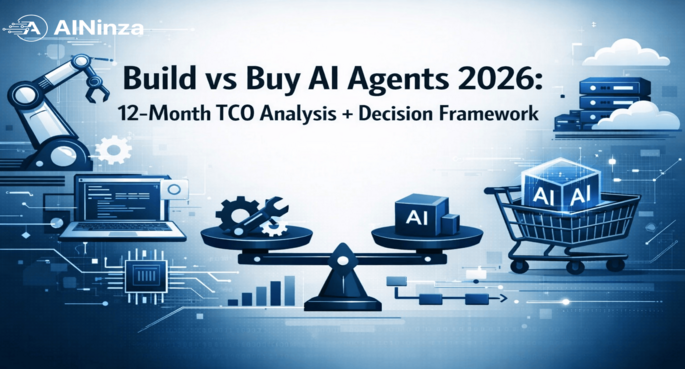

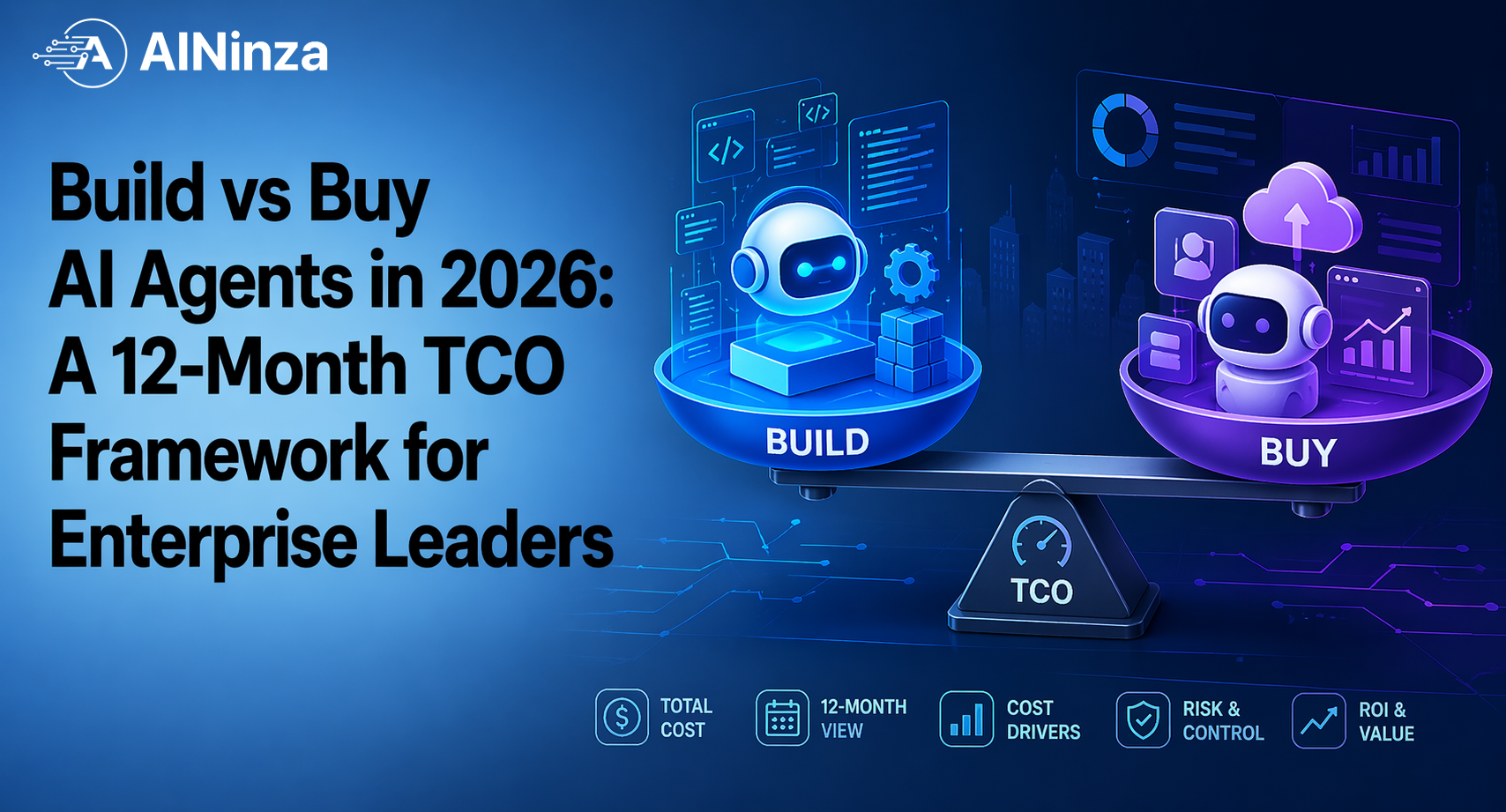
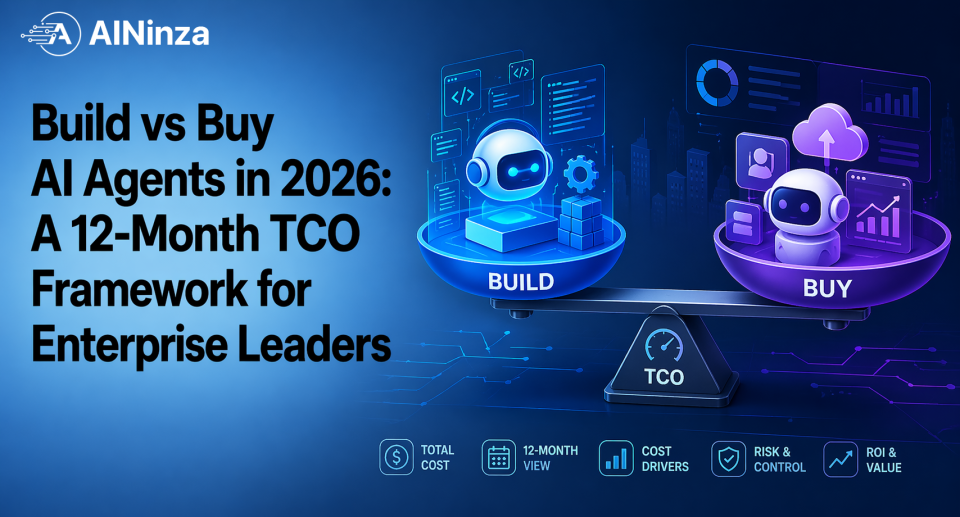
Build vs Buy AI Agents in 2026: A 12-Month TCO Framework for Enterprise Leaders

Most enterprise teams don’t screw up AI agent strategy because they pick the wrong model. They screw it up because they misprice the operating burden.
On paper, building your own AI agent stack looks smart. You get flexibility, tighter control, and the comforting illusion that your IP stays “in-house.” Buying looks faster, but more expensive over time. Then the real world shows up: orchestration breaks, evals are missing, prompt regressions pile up, model bills drift, compliance asks awkward questions, and suddenly the “cheap internal build” is a six-figure science project with no owner.
That’s the actual build-vs-buy decision in 2026. Not ideology. Not AI theater. Operating math.
This guide gives enterprise leaders a 12-month total cost of ownership (TCO) framework for deciding whether to build AI agents internally, buy a platform, or use a hybrid model. It also covers where teams underestimate cost, what timelines are realistic, when building actually makes sense, and the field reality nobody puts in the sales deck.
If your team is evaluating AI agents for support operations, internal knowledge search, sales workflows, underwriting assistance, or back-office automation, this is the question that matters: what option gets you to stable business value faster, with less hidden operational drag?
Why the Build-vs-Buy Question Got Harder in 2026
The old software logic was simpler. If the workflow was strategic, you built. If it was generic, you bought. AI agents broke that neat rule.
An AI agent is not just a feature. It is a moving system made up of prompts, models, retrieval layers, tool integrations, security controls, memory design, human review logic, observability, and continuous evaluation. Every one of those layers introduces cost and failure modes.
That matters because enterprise adoption is accelerating faster than governance maturity. McKinsey’s 2025 State of AI report shows AI usage is now mainstream across organizations, but meaningful value capture still depends on operating model redesign rather than just experimentation. Deloitte’s State of Generative AI in the Enterprise Q4 2025 report makes the same point from another angle: companies are moving past pilots, but ROI remains uneven because scaling requires discipline in workflow selection, controls, and delivery.
In other words, buying an AI agent platform is no longer just “buying software.” Building internally is no longer just “hiring engineers.” Both are operating model decisions.
The Only TCO Lens That Matters: 12-Month Cost to Stable Value
A lot of teams compare build versus buy using sticker price. That’s lazy math.
What you actually need is a 12-month TCO model that includes:
- Time to first production use case
- Time to stable performance
- Internal staffing cost
- Platform or vendor cost
- Integration and security cost
- Monitoring, evaluation, and optimization cost
- Risk-adjusted cost of delays and failures
The key phrase there is stable performance. A demo that works for three weeks is not business value. Stable value means the system survives real users, edge cases, policy reviews, and change requests without collapsing every sprint.
A practical 12-month TCO formula
Use this baseline:
12-Month TCO = Build/Platform Cost + Implementation Cost + Internal Labor Cost + Governance Cost + Run Cost + Failure/Delay Cost
For enterprise teams, the biggest mistake is usually underestimating the last three terms.
Cost Benchmarks: What Build Usually Looks Like
If you build AI agents internally, your first-year spend typically lands in five buckets.
1. Core product and engineering labor
A serious internal build usually needs at least:
– 1 product owner or business lead
– 1 AI/ML engineer or applied AI engineer
– 1 full-stack engineer
– 1 integration/backend engineer
– Shared security/compliance support
– Shared DevOps or platform support
Even if some of these are part-time allocations, the effective annualized cost adds up fast. In US/UK enterprise contexts, a lean cross-functional team can easily represent $180,000 to $450,000+ in loaded annual labor cost, depending on geography and seniority. If you need custom evaluation pipelines, regulated data handling, or deep system integrations, it climbs further.
2. Model, inference, and experimentation cost
Model cost is not the biggest line item early on, but it becomes meaningful once usage scales. Teams often burn budget during prototyping because they run too many manual tests, duplicate prompts, and wide-context calls without guardrails.
Deloitte’s work on the economics of AI highlights that token economics are reshaping solution design, which is exactly why poor orchestration decisions become expensive later. If your agent hits large contexts, calls multiple tools, or fans out across steps, inference cost can balloon quietly.
For many mid-market and enterprise pilots, annual model/runtime spend can range from $10,000 to $100,000+ depending on volume, model choice, and tool complexity.
3. Infrastructure and integration cost
Building means you also own:
– identity and access patterns
– vector storage or retrieval stack
– observability and logs
– secrets management
– queueing and retries
– environment separation
– API maintenance across connected systems
This is where teams lose months. The agent itself is often not the slow part. Enterprise plumbing is.
4. Evaluation, QA, and reliability cost
This is the most ignored line item.
A production AI agent needs repeatable evals, regression testing, fallback handling, confidence thresholds, and review workflows. NIST’s Generative AI Profile under the AI Risk Management Framework makes the case clearly: trustworthiness is not a one-time checklist; it requires ongoing measurement, monitoring, and governance. If you build, you own that discipline.
Expect meaningful ongoing effort here, not just a one-off setup task.
5. Change-management and adoption cost
If your agent affects frontline workflows, you also pay for enablement, SOP rewrites, manager buy-in, exception handling, and human-in-the-loop design.
Microsoft’s 2025 Work Trend Index pushes this point hard: the organizations moving faster with AI are redesigning work, not merely dropping tools on top of existing chaos. That is useful because it reframes ROI. If the workflow never changes, the agent rarely delivers full value.
Cost Benchmarks: What Buying Usually Looks Like
Buying an AI agent platform or implementation partner changes the cost shape, but not the need for discipline.
1. Platform or subscription fees
A commercial AI agent product may cost anywhere from $15,000 to $150,000+ annually depending on seats, usage, workflows, governance features, and support tier. Enterprise-grade platforms with security, private deployment options, auditability, and workflow tooling naturally sit at the higher end.
2. Implementation and onboarding fees
This is where buyers get misled. A vendor may say “go live in two weeks,” but enterprise readiness still needs:
– use-case design
– integration mapping
– permissions review
– prompt/system tuning
– stakeholder signoff
– test datasets
– rollout design
Realistically, implementation services can add $10,000 to $80,000+ depending on scope.
3. Internal owner cost still exists
Buying does not remove the need for an internal owner. You still need someone to define business logic, approve outputs, track quality, manage change requests, and own ROI.
The fantasy that buying means “no internal team required” is bullshit. You need a smaller internal team, not zero team.
4. Ongoing optimization and governance
If the vendor handles evals, prompt versioning, audit logs, and deployment pipelines well, you save a lot of hidden effort. If they do not, you merely outsourced the mess.
That is why vendor evaluation matters more than feature checklists.
Typical Timeline: Build vs Buy in the Real World
Here is a realistic enterprise timeline for a first meaningful use case.
If you build internally
- Weeks 1–3: use-case definition, stakeholder alignment, architecture choice
- Weeks 4–8: data access, integration prep, initial orchestration build
- Weeks 9–12: internal testing, prompt tuning, retrieval fixes, guardrails
- Months 4–6: pilot rollout, exceptions, instrumentation, eval creation
- Months 6–9: hardening, policy review, workflow redesign
- Months 9–12: stable expansion to additional teams or use cases
For most enterprises, a credible internal build takes 3–6 months to first production use and 6–12 months to stable repeatable value.
If you buy
- Weeks 1–2: vendor selection and scope lock
- Weeks 3–6: implementation, integration, taxonomy/setup
- Weeks 6–10: business testing and supervised rollout
- Months 3–5: optimization, adoption, expansion
A good vendor can get you to production materially faster, often in 6–10 weeks for a constrained first workflow, assuming internal approvals do not drag.
That speed difference matters more than people admit. If your target workflow touches customer response time, sales ops throughput, or analyst productivity, every quarter of delay has an opportunity cost.
A Side-by-Side 12-Month TCO Example
Let’s make this concrete.
Assume a 1,000-person company wants an AI agent for internal knowledge assistance plus workflow actions across support and operations.
Scenario A: Build internally
Year 1 estimated cost
– Product/AI/full-stack/integration labor allocation: $260,000
– Shared security/DevOps support: $40,000
– Model/runtime cost: $35,000
– Retrieval/infra/logging/tooling: $30,000
– Evaluation and QA effort: $35,000
– Change management and enablement: $20,000
– Delay/opportunity cost from slower rollout: $50,000–$150,000
Estimated 12-month TCO: $420,000 to $570,000
Scenario B: Buy platform + implementation support
Year 1 estimated cost
– Platform license: $70,000
– Implementation/onboarding: $35,000
– Internal owner and SME allocation: $60,000
– Additional integration work: $20,000
– Governance and optimization effort: $20,000
– Residual model/usage overages: $15,000
– Delay/opportunity cost: $15,000–$40,000
Estimated 12-month TCO: $220,000 to $260,000
That is not universal. But it is common enough to matter: buying is often 35% to 55% cheaper in year one for standardizable agent use cases, primarily because time-to-value and operating burden dominate license cost.
When Building Actually Wins
I’m not anti-build. Some teams absolutely should build.
Building tends to make sense when at least four of these are true:
- Your workflow is deeply differentiated and cannot be modeled well by an off-the-shelf product.
- You already have strong internal AI/platform talent with bandwidth, not just interest.
- You need unusual control over deployment, models, or compliance boundaries.
- The agent will become a core product capability, not just internal enablement.
- You expect multi-year strategic leverage from owning the orchestration layer.
- You can support continuous evaluation and maintenance as a product discipline.
If you lack those conditions, building often becomes a prestige project. And prestige projects are expensive.
When Buying Is the Smarter Move
Buying usually wins when:
- The use case is operational rather than strategically unique
- Speed matters more than architectural purity
- Your internal team is already capacity-constrained
- You need governance, auditability, and admin tooling out of the box
- You want proof of ROI before committing to a larger internal platform strategy
This is especially true for use cases like:
– internal knowledge assistants
– support copilots
– sales enablement assistants
– workflow triage and routing
– standard back-office automations
These are often valuable, but not unique enough to justify a large custom build upfront.
The Hybrid Option Is Usually the Best Enterprise Answer
Here’s the opinionated take: most enterprises should not choose pure build or pure buy. They should choose buy-first, customize selectively, and reserve custom build for differentiating layers.
That means:
– buy the control plane where possible
– buy governance and admin tooling if it is credible
– build custom integrations or domain workflows where you truly need them
– keep model portability in mind so you are not trapped later
This approach reduces year-one risk while preserving strategic flexibility.
It also matches what enterprise AI maturity actually looks like. Accenture’s 2025 work on enterprise reinvention argues that AI value depends heavily on redesigning how the business operates. Hybrid models are often better because they let companies move fast without pretending every layer needs to be proprietary.
Field Reality: Where Real AI Agent Projects Blow Up
Here’s the part teams usually learn the hard way.
The failure mode is rarely “the model was not smart enough.” The failure mode is usually one of these:
- nobody defined the escalation path when the agent was uncertain
- the retrieval layer pulled stale or conflicting documents
- the workflow owner changed requirements every two weeks
- compliance got involved after the pilot instead of before it
- nobody funded evals, so quality drift went unnoticed
- the pilot got declared a success before frontline adoption existed
That is why apparently cheap internal builds turn into expensive cleanup jobs.
In real projects, the boring stuff wins: access controls, content hygiene, exception handling, test cases, and owner accountability. If a vendor meaningfully reduces that burden, buying is often worth it. If a vendor cannot, then their fancy demo is just rented complexity.
A Decision Matrix You Can Use This Quarter
Use this simple scoring model. Rate each item from 1 to 5.
Build score factors
- strategic differentiation of workflow
- internal AI engineering strength
- need for custom deployment/control
- long-term platform ambition
- tolerance for slower year-one ROI
Buy score factors
- urgency of business outcome
- repeatability of workflow pattern
- need for fast rollout
- limited internal bandwidth
- importance of ready-made governance/admin features
If Build score beats Buy by 5+ points, explore custom build.
If Buy score beats Build by 5+ points, buy.
If scores are close, go hybrid.
This is blunt, but useful. It stops the conversation from becoming a religious war between engineering pride and procurement optimism.
Questions Every CXO Should Ask Before Signing Off
Whether you build or buy, ask these questions:
1. What is the first workflow, exactly?
Not “customer service.” Not “knowledge management.” Name the workflow.
2. What is the baseline metric?
Examples:
– average handling time
– turnaround time
– first-response time
– analyst throughput
– cost per case
– lead qualification speed
3. What is the acceptable error boundary?
If no one can answer this, your rollout is not ready.
4. Who owns evaluation after go-live?
If the answer is “the vendor” or “the data team” without a named business owner, expect drift.
5. What is the month-6 expansion logic?
Will the first use case become a platform? Or stay isolated? Both are fine, but decide.
What the External Data Is Really Telling Us
A few market signals matter here.
- McKinsey keeps showing that AI adoption is broad, but value capture separates the disciplined operators from the dabblers.
- Deloitte keeps showing that organizations are pushing beyond experiments, but many are still struggling to turn enthusiasm into hard ROI.
- Microsoft is effectively documenting the shift from tool usage to work redesign, which is where agent value compounds.
- PwC’s 2025 AI Jobs Barometer reports AI is associated with a fourfold increase in productivity growth in exposed industries and a 56% wage premium in AI-exposed jobs, which reinforces the upside case for getting implementation right rather than getting stuck in pilot purgatory.
- Stanford’s AI Index 2025 continues to show strong growth in enterprise AI activity and investment, but market momentum alone does not remove execution risk.
- NIST reminds everyone that trustworthy AI requires governance, measurement, and lifecycle controls, not vibes.
Taken together, the message is simple: the winner is usually not the team with the most custom architecture. It is the team that gets to controlled production fastest and learns with discipline.
Recommended Default for 2026
If you want the shortest honest answer:
- Buy for standard operational use cases.
- Build only where the workflow is truly differentiated or strategically core.
- Go hybrid if you need enterprise speed now and proprietary advantage later.
That is the call.
Most companies overestimate how much custom AI they need and underestimate how much operating discipline they lack. Buying a solid foundation and customizing selectively is usually the best business decision in year one.
FAQ
Is building AI agents cheaper than buying over the long term?
Sometimes, but not automatically. In year one, buying is often cheaper because it reduces implementation drag, internal labor requirements, and time-to-value. Over multiple years, building can become cheaper if the use case is highly strategic, scaled broadly, and supported by a mature internal platform team.
How long does it take to build an enterprise AI agent?
A realistic range is 3 to 6 months for first production use and 6 to 12 months for stable value, depending on integrations, governance, and workflow complexity.
When should an enterprise buy instead of build?
Buy when the workflow is common, the business outcome is urgent, internal engineering bandwidth is limited, or governance and admin tooling matter more than deep customization.
What hidden costs do teams miss in AI agent projects?
The biggest misses are evaluation, monitoring, exception handling, compliance reviews, workflow redesign, and the opportunity cost of slow rollout.
Is a hybrid AI agent strategy better than build or buy alone?
Usually, yes. A hybrid approach lets enterprises move faster with lower year-one risk while still building proprietary logic where it actually creates strategic advantage.
References
- McKinsey & Company. The State of AI: How Organizations Are Rewiring to Capture Value (2025). https://www.mckinsey.com/~/media/mckinsey/business%20functions/quantumblack/our%20insights/the%20state%20of%20ai/2025/the-state-of-ai-how-organizations-are-rewiring-to-capture-value_final.pdf
- Deloitte. State of Generative AI in the Enterprise: Q4 Report (2025). https://www2.deloitte.com/content/dam/Deloitte/bo/Documents/consultoria/2025/state-of-gen-ai-report-wave-4.pdf
- Deloitte. Navigate the Economics of AI (2025). https://www.deloitte.com/global/en/services/consulting/perspectives/how-to-navigate-economics-of-ai
- Microsoft WorkLab. 2025 Work Trend Index: The Frontier Firm Is Born (2025). https://www.microsoft.com/en-us/worklab/work-trend-index/2025-the-year-the-frontier-firm-is-born
- PwC. 2025 Global AI Jobs Barometer (2025). https://www.pwc.com/gx/en/issues/artificial-intelligence/job-barometer/2025/report.pdf
- Stanford HAI. AI Index Report 2025 (2025). https://hai.stanford.edu/assets/files/hai_ai_index_report_2025.pdf
- NIST. Artificial Intelligence Risk Management Framework: Generative Artificial Intelligence Profile (2024). https://www.nist.gov/publications/artificial-intelligence-risk-management-framework-generative-artificial-intelligence
- IBM Institute for Business Value. 2025 CEO Study: 5 Mindshifts to Supercharge Business Growth (2025). https://www.ibm.com/thought-leadership/institute-business-value/en-us/report/2025-ceo/
- Accenture. Reinventing Enterprise Models in the Age of Generative AI (2025). https://www.accenture.com/us-en/insights/consulting/gen-ai-reinventing-enterprise-models
Conclusion
The build-vs-buy AI agent debate is not really about control versus convenience. It is about whether your organization can absorb the cost of turning an unpredictable system into a dependable one.
If you need business value in the next two quarters, buying or going hybrid is usually the sane call. If you are building because the workflow is genuinely strategic and you have the talent to support it, go ahead—but budget for the boring operational layers, because that is where the real cost lives.
AINinza is powered by Aeologic Technologies, the enterprise engineering team behind practical AI systems, automation programs, and delivery-led transformation. If you want to evaluate whether your organization should build, buy, or hybridize its AI agent roadmap, start here: https://aeologic.com/