
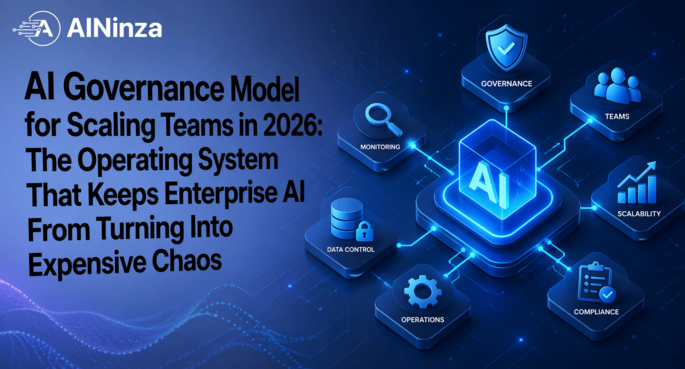
AI Governance Model for Scaling Teams in 2026: The Operating System That Keeps Enterprise AI From Turning Into Expensive Chaos

Most enterprise AI problems do not start with the model. They start with ownership confusion.
One team buys a copiloting tool. Another spins up a retrieval pipeline. A third starts testing agents in customer support. Nothing looks dangerous at first. Then six months later, leaders are dealing with duplicated vendors, inconsistent data controls, unclear approval rules, ballooning inference spend, and a messy question nobody wants to own: who is actually accountable when AI outputs go wrong?
That is why the companies getting real value from AI in 2026 are not just investing in models, prompts, or prototypes. They are building an AI governance model that works like an operating system. It defines who can approve what, what standards every team must follow, how risk is reviewed, how value is measured, and how teams scale without creating a governance traffic jam.
This article is for operators, digital leaders, CIOs, CTOs, COOs, and transformation heads who are past the hype cycle and now need a structure that can survive contact with reality. We will break down what a scalable AI governance model looks like, where teams usually screw it up, what numbers matter, and how to roll the model out without slowing delivery to a crawl.
Why AI Governance Becomes Urgent Once Pilots Turn Into Portfolio
AI governance sounds abstract until a company moves from one proof of concept to ten live initiatives.
At that point, the problem shifts. You are no longer asking, “Can this model work?” You are asking:
- Which use cases deserve approval first?
- What data can be used in prompting, fine-tuning, or retrieval?
- Which teams can buy tools directly, and which need central review?
- What level of human oversight is mandatory for customer-facing or regulated workflows?
- How do we compare ROI across AI projects using the same yardstick?
The urgency is real because adoption is already broad. McKinsey reported that 78% of organizations were using AI in at least one business function in 2024, up from 72% earlier in the year. Generative AI adoption also expanded quickly across functions, especially marketing, service operations, and software engineering. That kind of spread is exactly why informal decision-making stops working fast.
IBM’s Global AI Adoption Index found that 42% of large enterprises had actively deployed AI and another 40% were exploring or experimenting with it. In other words, most enterprise teams are not debating whether AI matters. They are debating how to stop fragmentation while still moving quickly.
That is the governance tension in one line: if controls are too loose, AI becomes chaos. If controls are too rigid, AI becomes theater.
What an AI Governance Model Actually Is
A lot of teams confuse governance with policy documents. That is too shallow.
A real AI governance model is the set of decision rights, standards, review mechanisms, and operating routines that tell the organization how AI gets proposed, approved, built, monitored, and retired.
It usually covers five layers:
1. Strategic governance
This layer decides where AI should be used at all. It prioritizes business domains, capital allocation, target outcomes, and risk appetite.
2. Delivery governance
This defines how use cases move from idea to production. It covers stage gates, architecture patterns, testing expectations, and rollout approval.
3. Risk and compliance governance
This handles data sensitivity, privacy, model risk, legal review, auditability, security controls, bias monitoring, and sector-specific obligations.
4. Financial governance
This tracks budgets, vendor usage, token or inference spend, infrastructure costs, and ROI expectations. It also prevents shadow AI spend from getting out of hand.
5. Operational governance
This covers ongoing monitoring, incident response, retraining or refresh logic, fallback procedures, human review thresholds, and retirement criteria.
If even one of these layers is vague, the whole system gets weird. Teams either over-escalate everything or bypass controls entirely.
The Core Design Principle: Central Standards, Distributed Execution
This is the part many enterprises miss.
The best governance models are not fully centralized and they are not fully federated. They are centrally opinionated and locally executable.
That means the center defines the rules of the road, but business and product teams still build and deploy within those guardrails.
A practical split looks like this:
| Governance Area | Central Team Owns | Domain Teams Own |
|---|---|---|
| Risk taxonomy | Risk tiers, review rules, approval criteria | Correct classification of each use case |
| Architecture patterns | Approved model, RAG, agent, and HITL patterns | Implementation within approved patterns |
| Data controls | Sensitive data rules, access policy, logging standards | Dataset selection and justified access requests |
| Vendor policy | Evaluation scorecard, security review, commercial guardrails | Business case and workflow fit |
| KPI model | Standard ROI and performance metrics | Use-case level target tracking |
| Monitoring | Minimum monitoring and incident standards | Day-to-day operational review |
Deloitte’s State of Generative AI in the Enterprise research has repeatedly shown that organizations moving from experimentation to scaled value are formalizing governance structures rather than leaving AI decisions to isolated teams. That matches what you see in the field. Enterprises that scale well create a small central nervous system, not a bloated command center.
The Seven Components of a Scalable AI Governance Model
You do not need a 70-page framework to get started. You do need seven components that actually connect.
1. An AI steering group with real authority
Call it an AI council, transformation board, or governance committee if you want. The name matters less than the power.
This group should include business leadership, technology, data, security, legal or compliance, and delivery leadership. In many companies, the right size is 6 to 10 decision-makers. Bigger than that and you are building a calendar problem, not a governance model.
Its job is to:
– Prioritize the use case portfolio
– Set risk appetite by business domain
– Resolve cross-functional conflicts
– Approve exceptions to standards
– Review value realization quarterly
The steering group should not review every tiny workflow. It should govern the system, not micromanage prompts.
2. A use-case intake and tiering framework
Every AI initiative should enter through the same intake logic.
A lightweight intake form should capture:
– Business problem and target KPI
– Workflow owner
– User group impacted
– Data types involved
– Model pattern proposed, such as copilots, RAG, predictive models, or agents
– Required integrations
– Estimated gain, such as cycle-time reduction, cost savings, revenue lift, or service improvement
– Risk tier
A useful risk-tier structure often looks like this:
- Tier 1: internal productivity with low-risk data and human review
- Tier 2: operational decision support with moderate business impact
- Tier 3: customer-facing, regulated, or financially material use cases
- Tier 4: autonomous actions, sensitive data exposure, or high legal risk
The point is not bureaucracy. The point is routing. Low-risk use cases should move in days, not months. High-risk ones deserve deeper review.
3. A standard architecture policy
Teams move faster when they are not reinventing technical patterns every time.
Your governance model should define approved reference patterns for common use cases:
– Internal knowledge assistant using retrieval and access controls
– Human-in-the-loop workflow assistant for operations
– Customer support copilot with escalation rules
– Agentic workflow with action thresholds and approval checkpoints
– Fine-tuned model pattern for narrow enterprise tasks
This matters because architecture choices change both cost and risk.
Stanford’s 2025 AI Index notes that model performance continues to improve while cost curves for inference have dropped sharply for some benchmark workloads. That is good news, but it also tempts teams to deploy quickly without thinking through integration, auditability, or data boundaries. Cheap tokens can still produce expensive mistakes.
4. Clear model and vendor approval rules
The average enterprise stack gets messy fast. Teams buy foundation model APIs, niche copilots, vector databases, evaluation tools, guardrail layers, and orchestration platforms. If there is no common vendor process, procurement sprawl arrives right on schedule.
Your governance model should define:
– Which vendors are pre-approved
– What security and privacy review is required
– What commercial thresholds trigger legal or procurement review
– Rules for training on customer data
– Data residency requirements
– Exit and portability expectations
This is especially important because vendor lock-in risk is not theoretical anymore. BCG has argued that AI leaders are separating experimentation from enterprise-scale value capture by making sharper portfolio and platform choices early. The wrong vendor stack can trap a team in high cost and low flexibility within a year.
5. Human oversight rules that are specific, not vague
“Humans should remain in the loop” sounds nice and means almost nothing unless defined.
Governance needs explicit rules such as:
– Which outputs must be reviewed before release
– Maximum autonomy levels by use case tier
– When agents can trigger actions without approval
– Acceptable confidence thresholds for automation
– Escalation rules when outputs fall outside normal parameters
For example, an internal sales summarization assistant may only need spot checks and prompt logging. A claims-processing workflow, pricing recommendation engine, or employee policy advisor probably needs structured approval rules, audit traces, and exception handling.
NVIDIA’s State of AI reports in regulated and high-value sectors keep pointing to the same issue: enterprises get value from automation, but trust increases when governance and explainability are designed into operations, not bolted on later.
6. A measurement model tied to business value
Too many AI governance programs measure activity instead of outcomes.
You need three measurement levels:
Portfolio metrics
- Number of active AI initiatives
- Share of initiatives by risk tier
- Deployment rate from pilot to production
- Total AI spend by vendor or platform
- Portfolio ROI trend
Use-case metrics
- Cycle-time reduction
- Labor hours saved
- Revenue influenced
- Containment or deflection rate
- Error-rate change
- Human review rate
- Adoption rate among intended users
Governance health metrics
- Review turnaround time
- Policy exception rate
- Incident frequency
- Audit finding count
- Percentage of use cases with named owner and KPI baseline
PwC’s 2025 AI Jobs Barometer found that industries more exposed to AI were seeing higher productivity growth, but productivity benefit is not automatic. Measurement discipline is what tells you whether you have real operating leverage or just interesting demos.
7. Lifecycle controls after launch
A use case that passed review six months ago may now be noncompliant, too costly, or simply useless.
So governance needs post-launch rules:
– Revalidation cadence for high-risk systems
– Trigger thresholds for review after incidents or material changes
– Performance drift checks
– Retrieval source review for RAG systems
– Prompt and policy update logging
– Retirement criteria when business value drops
This is boring compared with model demos. It is also where mature teams quietly win.
A Practical Operating Model for Scaling Teams
If you are building this from scratch, do not launch with a giant enterprise framework. Start with a four-part operating model.
Policy spine
Create a short central policy set covering data use, risk tiers, vendor approval, human oversight, and monitoring expectations.
Delivery path
Define one intake route, one review path by risk level, and one go-live checklist.
Platform guardrails
Standardize approved tools, logging, model access, retrieval patterns, and security controls.
Governance cadence
Run weekly working reviews for active initiatives and monthly or quarterly executive reviews for portfolio decisions.
Microsoft’s 2024 Work Trend Index made one thing obvious: AI usage is spreading through the workforce faster than many formal operating models can keep up. That is exactly why lightweight, durable governance beats slow committee theatre.
Field Reality: Where Governance Programs Usually Break
Here is the ugly bit.
Most AI governance efforts do not fail because the policies are too weak. They fail because the model is disconnected from delivery.
In real teams, the breakdown usually looks like this:
- The governance board meets monthly, but product teams ship weekly.
- Legal reviews happen too late, so teams hide experiments until contracts are already in motion.
- Architecture standards are documented, but nobody owns reusable implementation patterns.
- Risk tiers exist on paper, but everything gets escalated because nobody trusts the intake criteria.
- ROI is estimated at kickoff, then never measured after launch.
That creates predictable behavior. Teams work around governance because governance feels like a blocker rather than an enabler.
The fix is simple to say and harder to do: governance must be embedded into delivery tooling, templates, approval flows, and operating rituals. If it lives only in PowerPoint, it is dead on arrival.
Benchmarks and Numbers Leaders Should Actually Watch
A scalable governance model should produce better speed and better control at the same time. If it only produces one, it is broken.
These are the benchmarks worth tracking:
Review turnaround time
- Tier 1 use cases: target under 5 business days
- Tier 2 use cases: target 1 to 2 weeks
- Tier 3 or 4 use cases: target 2 to 4 weeks depending on regulatory complexity
If low-risk internal use cases take a month to approve, teams will absolutely go rogue.
Pilot-to-production conversion
A healthy portfolio should not have endless prototype churn. Depending on maturity, many organizations should target 25% to 40% of funded pilots reaching production with measurable business KPIs. If you are below that, intake quality or execution discipline is off.
Named ownership coverage
100% of production AI systems should have a business owner, technical owner, and risk owner. Anything less is a future incident waiting for a date.
Cost visibility
100% of production AI workloads should have attributable spend tracking, ideally by vendor, business unit, and use case. Without that, CFO conversations turn spicy for very good reasons.
Incident learning loop
Every significant AI incident should produce a policy, monitoring, or pattern update. If the incident happens twice, governance learned nothing.
McKinsey, IBM, and Deloitte all point to the same broader trend: AI adoption is accelerating, but value capture depends on management systems, not enthusiasm. Governance is one of those systems.
How to Roll Out an AI Governance Model in 90 Days
A lot of leaders think governance requires a six-month design project. It does not. A usable version can be launched in 90 days.
Days 1 to 30: set the spine
- Name executive sponsor and working lead
- Define 3 to 4 risk tiers
- Publish approved and restricted data-use rules
- Build one standard intake form
- Create first-pass vendor review checklist
- Identify 5 to 10 active AI initiatives for governance retrofit
Days 31 to 60: operationalize the flow
- Launch weekly use-case triage review
- Approve 2 to 3 standard reference architectures
- Define minimum logging, testing, and monitoring standards
- Assign business, technical, and risk owners for each live initiative
- Publish go-live checklist for high-risk and low-risk use cases
Days 61 to 90: connect governance to value
- Build portfolio dashboard with spend, risk tier, status, and KPI baselines
- Review live use cases for ROI and adoption quality
- Kill low-value projects that do not justify continued spend
- Tighten approval rules based on real bottlenecks
- Document exception handling so teams are not stuck waiting for ad hoc calls
That kind of rollout is realistic because it focuses on operating clarity, not bureaucracy cosplay.
What Different Leaders Should Own
AI governance dies when everyone assumes someone else has it covered.
CIO or CTO
Owns the platform standards, tool rationalization, architecture patterns, and technical control environment.
COO or transformation lead
Owns process integration, operating cadence, and ensuring governance actually fits delivery motion.
CISO or security lead
Owns model, vendor, data, and access risk controls, plus incident response linkage.
Legal and compliance
Own review policies for regulated use cases, contracts, content liability, privacy, and audit readiness.
Business unit leaders
Own business cases, target KPIs, workflow adoption, and operational accountability for results.
Finance
Owns cost visibility, value measurement discipline, and commercial guardrails.
If those roles are fuzzy, your governance model will be fuzzy too.
Common Mistakes to Avoid
A few mistakes show up over and over.
Mistake 1: treating every use case like a high-risk use case
This slows the organization and teaches teams to hide things.
Mistake 2: letting every team choose tools independently
This creates duplicated spend, fragmented security posture, and integration hell.
Mistake 3: writing principles without operating mechanisms
A principle that does not change intake, review, design, or monitoring is decorative.
Mistake 4: forgetting post-launch governance
Launch is not the finish line. It is where accountability starts.
Mistake 5: measuring AI activity instead of business impact
Ten pilots and five dashboards do not matter if cycle time, revenue, or margin did not improve.
FAQ
What is the difference between AI governance and AI policy?
AI policy is one part of governance. Governance is broader. It includes who makes decisions, how projects are reviewed, what controls are mandatory, how value is measured, and how live systems are monitored over time.
Who should own AI governance in an enterprise?
There should be executive sponsorship at the top, usually from a CIO, CTO, COO, or digital transformation leader. But ownership is shared. Technology, security, legal, finance, and business teams all need defined roles.
How big should an AI governance committee be?
Usually 6 to 10 core decision-makers is enough. Larger groups slow decisions and create noise. Bring in specialists when needed rather than stuffing the core committee.
Does governance slow AI delivery?
Bad governance does. Good governance speeds it up by clarifying rules, standardizing patterns, and reducing rework. The fastest teams usually have the clearest operating model.
What should be reviewed first in a governance program?
Start with use-case intake, risk tiers, data-use rules, vendor approval logic, and minimum human oversight requirements. Those five pieces create immediate control without building a giant framework.
Conclusion
If your company plans to scale AI beyond a handful of pilots, governance is not optional. It is the structure that keeps speed from becoming recklessness and keeps control from becoming paralysis.
The teams that win in 2026 will not be the ones with the most AI experiments. They will be the ones with the clearest operating model, sharpest decision rights, and strongest discipline around value, risk, and ownership.
A practical AI governance model gives teams room to move, but not room to improvise with enterprise risk. That is the balance worth building.
References
- McKinsey, The State of AI, https://www.mckinsey.com/capabilities/quantumblack/our-insights/the-state-of-ai
- IBM, Global AI Adoption Index 2024, https://www.ibm.com/reports/ai-adoption
- Deloitte, State of Generative AI in the Enterprise, https://www2.deloitte.com/us/en/insights/focus/cognitive-technologies/state-of-generative-ai-in-the-enterprise.html
- Stanford HAI, AI Index Report 2025, https://hai.stanford.edu/ai-index/2025-ai-index-report
- PwC, 2025 AI Jobs Barometer, https://www.pwc.com/gx/en/issues/artificial-intelligence/job-barometer.html
- Microsoft, 2024 Work Trend Index, https://www.microsoft.com/en-us/worklab/work-trend-index/2024-the-year-ai-at-work-begins
- BCG, Where’s the Value in AI?, https://www.bcg.com/publications/2024/where-is-the-value-in-ai
- NVIDIA, State of AI in Financial Services, https://www.nvidia.com/en-us/industries/financial-services/state-of-ai-in-financial-services/
- NIST, AI Risk Management Framework, https://www.nist.gov/itl/ai-risk-management-framework
- OECD, Recommendation of the Council on Artificial Intelligence, https://oecd.ai/en/ai-principles
AINinza is powered by Aeologic Technologies, which helps enterprises design, build, and operationalize AI systems that survive real-world complexity. If you are planning to scale AI across teams and need a governance model that balances speed, control, and commercial outcomes, talk to Aeologic: https://aeologic.com/