
Enterprise AI Vendor Evaluation: A 30-Point Scorecard for Choosing the Right Partner in 2026

Buying enterprise AI is rarely a model problem. It is a delivery problem wearing a glossy demo.
That is why so many teams get burned. A vendor shows a smart copilot, promises a 6-week rollout, and waves around benchmark slides. Three months later, the pilot is trapped between IT, security, operations, and unclear ownership. Nobody agrees on the success metric, costs start leaking in from integration work, and the internal team realizes the “out of the box” solution needs a lot more box than advertised.
The timing matters. Gartner said generative AI became the most frequently deployed AI solution in organizations in 2024, while also predicting that 30% of generative AI projects would be abandoned after proof of concept by the end of 2025. That combination tells you everything you need to know. Interest is real. Waste is real too.
So this article is built for the buyer, not the hype machine. If you are comparing AI vendors, platforms, or implementation partners in 2026, you need a framework that checks commercial fit, technical reality, governance strength, and implementation competence in one pass.
Below is a practical 30-point scorecard you can use during evaluation, bake into RFPs, or bring into a board-level decision meeting. It is opinionated on purpose. In enterprise AI buying, a vague framework is worse than no framework at all.
Why AI vendor selection is harder in 2026
Enterprise AI buying has become messier for three reasons.
First, the market has fragmented. You are no longer choosing between just a software platform and a systems integrator. You may be comparing vertical AI products, orchestration layers, model providers, data-stack vendors, security overlays, and service partners offering “end-to-end AI transformation.” A lot of these vendors overlap in slide decks but not in accountability.
Second, the economic case is under more scrutiny. McKinsey’s 2025 State of AI research shows organizations are starting to rewire processes to capture value from gen AI, but the winners are the ones that link AI to workflow redesign, risk controls, and operating model changes. In plain English, throwing a tool at a broken process does not produce ROI. It produces a more expensive broken process.
Third, governance is no longer optional. NIST’s AI RMF and the Generative AI Profile, Microsoft’s Responsible AI transparency reporting, and OWASP’s vendor evaluation criteria for AI red teaming all point in the same direction: buyers are expected to ask harder questions on data handling, model risk, monitoring, and misuse controls. If your vendor cannot answer them, that is not a maturity gap. It is a buying signal to walk away.
The 4 buyer mistakes that waste the most money
Before the scorecard, let’s kill the usual mistakes.
1. Buying the demo instead of the operating model
A beautiful demo proves the vendor can script a happy path. It does not prove they can survive your permissions model, your messy source data, your approval chain, or your legal review.
2. Comparing tools without comparing total cost
The sticker price is only part of the cost. Real spend usually includes implementation, prompt and workflow tuning, data preparation, integration work, change management, usage-based model charges, monitoring, and support.
3. Treating “AI platform” as a category with shared meaning
It is not. Some vendors sell model access. Some sell workflow automation with AI features. Some sell agent frameworks. Some sell consulting wrapped around open-source components. If you do not normalize the category, your evaluation table is garbage.
4. Leaving security and governance for procurement week
That is how teams end up with a preferred vendor that fails security review after six weeks of internal selling. Get governance questions in early, or pay in lost time later.
The 30-point enterprise AI vendor scorecard
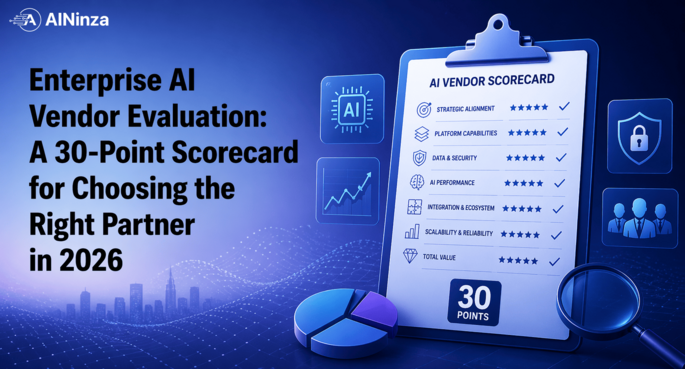
Use a 1 to 5 rating for each line item, where 1 means weak or unproven and 5 means strong, validated, and reference-backed. Multiply the raw score by the weight. A score above 80 out of 100 usually indicates a credible short-list candidate. Below 65 means you are probably still looking at smoke.
Section 1: Business fit and ROI credibility (25 points)
1. Problem-solution fit
Does the vendor solve a defined business problem with measurable outcomes, or are they pitching general AI capabilities with no strong use-case anchoring?
2. Time-to-value realism
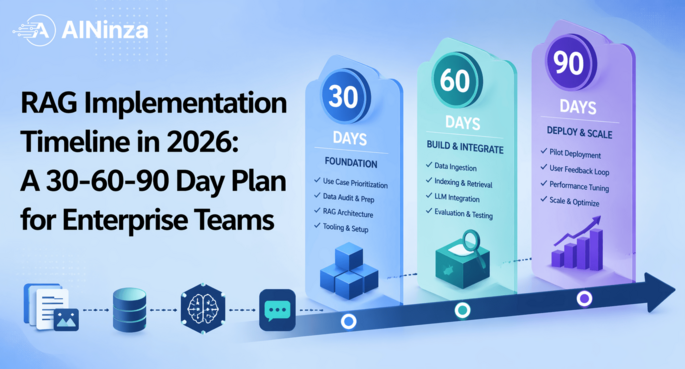
Can they show credible implementation milestones for 30, 60, and 90 days? For most enterprise AI programs, anything promising enterprise-wide transformation in under 8 weeks deserves skepticism.
3. ROI model quality
Do they provide a transparent model for benefit estimation, including labor savings, cycle-time reduction, revenue uplift, or error-rate reduction?
4. Benchmark evidence
Can they cite customer outcomes with concrete numbers? Strong examples include 20% to 40% handling-time reduction, 15% to 30% faster knowledge retrieval, or measurable conversion lift in bounded workflows.
5. Buyer-side effort clarity
Do they clearly state what your team must supply, including SMEs, data owners, IT support, legal input, and change management capacity?
Section 2: Delivery and implementation competence (25 points)
6. Integration capability
Can the vendor integrate with your CRM, ERP, ticketing, document systems, identity layer, and internal APIs without heroic custom work?
7. Data readiness approach
Do they have a disciplined method for handling poor source quality, fragmented knowledge bases, and permissioned access?
8. Workflow design depth
Can they redesign the end-to-end workflow, or do they just insert a chatbot and call it automation?
9. Human-in-the-loop design
Do they know when humans must approve, override, or audit outputs? Mature vendors design escalation and exception handling from day one.
10. Change management support
Do they provide training, enablement, adoption metrics, and operating playbooks, not just technical setup?
Section 3: Technical architecture and scalability (20 points)
11. Model strategy
Can they explain when they use frontier APIs, open-source models, small models, or hybrid architectures, and why?
12. Retrieval and knowledge design
If the use case touches enterprise knowledge, can they justify chunking, embeddings, access controls, freshness logic, and citation behavior?
13. Latency and throughput expectations
Do they give realistic performance expectations under production load, not just in sandbox mode?
14. Monitoring and observability
Can they track output quality, failures, usage, drift, cost, and user feedback over time?
15. Portability and lock-in risk
How difficult would it be to swap models, move providers, or internalize pieces of the stack later?
Section 4: Governance, security, and risk controls (20 points)
16. Data handling transparency
Can they clearly describe what data is stored, where it is processed, what is retained, and what is used for model improvement?
17. Access control and identity integration
Do they support SSO, RBAC, audit logging, and enterprise-grade permissioning?
18. AI safety and misuse controls
Can they describe guardrails for prompt injection, data leakage, harmful outputs, and policy-violating actions?
19. Testing and red teaming
Do they perform structured testing for hallucinations, jailbreaks, workflow abuse, and failure cases before rollout?
20. Regulatory and policy readiness
Can they map their controls to internal policy, industry obligations, and frameworks such as NIST AI RMF?
Section 5: Commercial structure and vendor reliability (10 points)
21. Pricing clarity
Is pricing easy to model across licenses, usage, implementation, and ongoing support?
22. Support and SLA quality
Do they provide clear escalation paths, response times, and ownership boundaries?
23. Reference quality
Can they provide relevant customer references from similar company size, industry, or complexity?
24. Product roadmap credibility
Is the roadmap coherent, or is it a pile of AI buzzwords taped together after every model release?
25. Financial and organizational stability
Will this vendor realistically be around in 24 months, and do they have the team to support expansion?
The 5 bonus questions that separate serious vendors from slideware
These are the tie-breakers. They are often where weak vendors crack.
26. What exactly breaks when source data is incomplete or messy?
A strong vendor answers with fallback logic, exception handling, confidence thresholds, and user alerts. A weak vendor says, “our model is robust.” That means nothing.
27. What percentage of implementation effort usually sits with the client?
If they cannot estimate this, they probably under-scope projects.
28. Where do you see the highest failure rate in production deployments?
A good partner will admit common failure modes. Honesty here is worth more than polished optimism.
29. Which parts of your stack are proprietary, and which are replaceable?
This tells you how trapped you may be later.
30. What proof do you have that users keep using the system after launch?
Adoption matters. A deployed AI system nobody trusts is just a fancy invoice.
How to score vendors in practice
The cleanest approach is to rate each vendor across the same scorecard in a shared sheet, with three evaluators minimum: one business owner, one technical lead, and one risk or security reviewer. Average the scores, then discuss the largest score gaps.
That conversation matters because misalignment tells you where risk is hiding. If the business team gives a vendor 5 out of 5 for fit, but security rates them 2 out of 5 for data handling, that is not a minor disagreement. That is a deal structure problem waiting to explode.
A simple weighting model works well:
- Business fit and ROI credibility: 25%
- Delivery and implementation competence: 25%
- Technical architecture and scalability: 20%
- Governance, security, and risk controls: 20%
- Commercial structure and vendor reliability: 10%
For highly regulated environments, increase governance weight to 25% and reduce commercial weight. For a fast-moving internal productivity use case, you can keep commercial weight lower but you still should not gut governance. IBM’s 2025 Cost of a Data Breach reporting keeps making the same point in different ways: weak oversight gets expensive fast.
Sample vendor comparison table
Here is a simplified scoring view for three fictional vendors.
| Criteria Block | Weight | Vendor A Platform | Vendor B SI Partner | Vendor C Vertical AI |
|---|---|---|---|---|
| Business fit and ROI | 25 | 18 | 20 | 22 |
| Delivery competence | 25 | 16 | 22 | 17 |
| Technical architecture | 20 | 17 | 15 | 16 |
| Governance and security | 20 | 14 | 17 | 15 |
| Commercial and reliability | 10 | 8 | 7 | 6 |
| Total | 100 | 73 | 81 | 76 |
This kind of table helps expose tradeoffs. The systems integrator may score better on delivery and change management, while the platform vendor may have stronger architecture but weaker hands-on implementation support. The vertical AI player might show excellent problem fit but carry more lock-in risk.
That is why “best vendor” is the wrong question. The real question is, “best vendor for this use case, this team maturity, this risk profile, and this timeline.”
Field reality: where AI vendor deals usually go sideways
Here is the blunt version.
Most enterprise AI failures are not caused by model quality alone. They fail because the buying team underestimates operational friction. Data owners move slowly. Legal wants clarity on retention. Security blocks external connectors. The internal sponsor changes priorities. Frontline teams do not trust the output. Nobody has defined who owns prompt changes or exception handling after go-live.
I have seen vendors lose credibility not because the product was bad, but because they sold a phase-two operating model as if it were phase one. They priced the initial deal like a software setup when the reality was a cross-functional transformation project.
If a vendor does not push back on your assumptions at least a little, be careful. Serious partners usually introduce healthy discomfort early. That is often a sign they understand the terrain.
What strong vendor answers actually sound like
When you ask mature vendors hard questions, their answers tend to share the same characteristics.
They quantify uncertainty. They say things like, “In similar deployments, 25% to 35% of the timeline depended on client-side system access and data owner availability.”
They distinguish pilot metrics from scale metrics. They will tell you a pilot may show response quality gains in two weeks, but stable business impact takes 60 to 90 days of workflow tuning and adoption work.
They talk about exception paths. Instead of promising perfection, they explain fallback logic, confidence thresholds, human approval design, and monitoring.
They separate platform capability from service effort. That is critical for clean commercials.
And they can explain architecture without turning the meeting into a graduate seminar.
A sharper RFP checklist for enterprise AI buyers
If you are formalizing a vendor selection process, require these artifacts from every serious bidder:
- A use-case-specific solution architecture
- A 30/60/90 day implementation plan
- Named assumptions and buyer dependencies
- Security and data-handling documentation
- A monitoring and post-launch support plan
- Reference customers with comparable complexity
- A transparent cost model covering implementation and run-state operations
- A clear statement of what is configurable versus custom
This one move alone improves the quality of vendor conversations. It forces specificity, and specificity is where truth lives.
When to choose a platform, a services partner, or a hybrid
There is no universal winner, but there is a smart default.
Choose a platform-led vendor when your internal engineering and operations teams are strong, your use cases are repeatable, and you want long-term control.
Choose a services-led partner when the internal team lacks AI delivery experience, change management capacity, or architectural decision-making confidence.
Choose a hybrid model when you need both a scalable technology base and implementation muscle. In practice, this is often the best path for mid-market and enterprise buyers trying to move fast without creating permanent dependency.
The mistake is pretending these models are interchangeable. They are not.
FAQ
What is the most important factor in enterprise AI vendor evaluation?
Problem-solution fit tied to measurable business value. A technically impressive vendor with weak workflow fit usually underdelivers.
How many vendors should be in an enterprise AI shortlist?
Three is ideal. Two can create blind spots, and more than four usually adds noise unless procurement rules require it.
What is a good target score on an AI vendor scorecard?
A weighted score above 80 out of 100 is typically strong. Between 65 and 80 means promising but with material gaps. Below 65 usually means the vendor is not ready for your context.
Should buyers prioritize security or speed in AI deployments?
Security and governance should be built into speed, not treated as a separate brake. If a vendor cannot move fast with control, they are not enterprise-ready.
How do you avoid lock-in with AI vendors?
Ask about portability early, especially model abstraction, export access, architecture modularity, and ownership of prompts, workflows, and evaluation data.
What should an AI vendor provide before a paid pilot starts?
At minimum: solution scope, success metrics, dependencies, implementation plan, data assumptions, security posture, commercial model, and named stakeholders.
References
- Gartner, “Survey Finds Generative AI Is Now the Most Frequently Deployed AI Solution in Organizations” (2024): https://www.gartner.com/en/newsroom/press-releases/2024-05-07-gartner-survey-finds-generative-ai-is-now-the-most-frequently-deployed-ai-solution-in-organizations
- Gartner, “Predicts 30% of Generative AI Projects Will Be Abandoned After Proof of Concept by End of 2025” (2024): https://gcom.pdo.aws.gartner.com/en/newsroom/press-releases/2024-07-29-gartner-predicts-30-percent-of-generative-ai-projects-will-be-abandoned-after-proof-of-concept-by-end-of-2025
- McKinsey, “The State of AI: How Organizations Are Rewiring to Capture Value” (2025): https://www.mckinsey.com/capabilities/quantumblack/our-insights/the-state-of-ai-how-organizations-are-rewiring-to-capture-value
- Deloitte, “State of Generative AI in the Enterprise, Q4 Report” (2025): https://www2.deloitte.com/content/dam/Deloitte/bo/Documents/consultoria/2025/state-of-gen-ai-report-wave-4.pdf
- NIST, “Artificial Intelligence Risk Management Framework: Generative Artificial Intelligence Profile” (2024): https://www.nist.gov/publications/artificial-intelligence-risk-management-framework-generative-artificial-intelligence
- NIST, “Artificial Intelligence Risk Management Framework (AI RMF 1.0)” (2023): https://nvlpubs.nist.gov/nistpubs/ai/NIST.AI.100-1.pdf
- Microsoft, “Responsible AI Transparency Report” (2025): https://www.microsoft.com/en-us/corporate-responsibility/responsible-ai-transparency-report
- IBM, “Cost of a Data Breach Report 2025” (2025): https://www.ibm.com/think/x-force/2025-cost-of-a-data-breach-navigating-ai
- OWASP, “Vendor Evaluation Criteria for AI Red Teaming Providers & Tooling v1.0” (2026): https://genai.owasp.org/resource/owasp-vendor-evaluation-criteria-for-ai-red-teaming-providers-tooling-v1-0/
- Stanford HAI, “AI Index Report 2025” (2025): https://hai.stanford.edu/ai-index/2025-ai-index-report
- PwC, “28th Annual Global CEO Survey” (2025): https://www.pwc.com/gx/en/ceo-survey/2025/28th-ceo-survey.pdf
Conclusion
Enterprise AI vendor selection should not be driven by the best demo, the loudest roadmap, or the cheapest pilot. It should be driven by delivery reality.
The teams that buy well in 2026 will use structured scorecards, weight implementation competence heavily, force specificity early, and test governance before internal momentum gets expensive. That does not eliminate risk. It does eliminate a lot of preventable stupidity.
If you are evaluating vendors right now, use the scorecard above as your baseline and adapt the weights to your business context. Just do not walk into the decision with a beauty contest rubric and call it diligence.
AINinza is powered by Aeologic Technologies, which helps enterprises design, build, and operationalize practical AI systems that survive real-world delivery. If you want help evaluating AI vendors, shaping an implementation roadmap, or pressure-testing commercial assumptions, talk to the team at https://aeologic.com/