
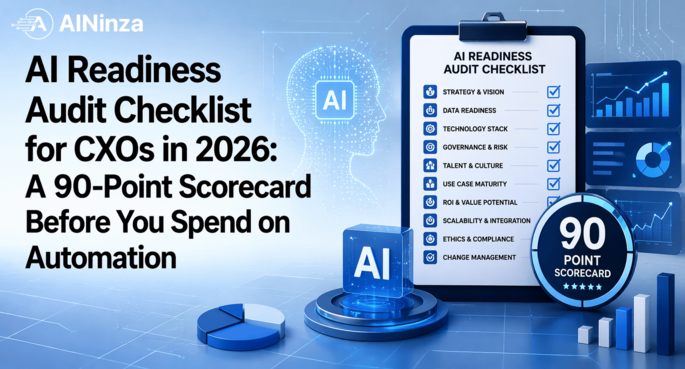
AI Readiness Audit Checklist for CXOs in 2026: A 90-Point Scorecard Before You Spend on Automation

Most AI programs do not fail because the model is weak. They fail because the business is not ready.
Teams buy tools first, then discover the hard part: fragmented data, unclear owners, messy workflows, legal blockers, and no agreed baseline for ROI. The result is predictable, pilot-heavy activity with very little production impact.
If you are a CXO approving budget for 2026, you need a simple answer before saying yes: Are we actually ready to convert AI spend into operational value in the next 90 to 180 days?
This guide gives you a practical 90-point AI readiness audit checklist you can run with your leadership team in one week. You will get a score, a risk profile, and a clear go, fix, or defer recommendation.
Why an AI readiness audit is now non-negotiable
Enterprise AI has moved from experimentation to execution pressure. According to Stanford’s 2025 AI Index, model capability and adoption momentum continue to accelerate, while cost curves for inference are improving. That sounds positive, but it creates a management trap: leaders assume lower model cost means lower implementation risk. It does not.
In practice, your risk sits in operations, not in the LLM.
McKinsey’s latest State of AI work shows organizations are using AI in more business functions, but only a smaller subset sees material bottom-line impact at scale. The difference usually comes down to execution discipline: process design, governance, and change management.
If your board wants speed and your teams want clarity, readiness scoring is the fastest way to align both.
The 90-point scoring model (how to use it)
Score each section from 0 to 15 across six readiness pillars. Total = 90 points.
- 75 to 90: Green zone, proceed with implementation roadmap.
- 60 to 74: Yellow zone, proceed only with a constrained phase 1 and hard risk controls.
- Below 60: Red zone, fix foundations first or you will burn budget.
Use a cross-functional working group:
– Business owner (P&L accountability)
– Operations lead (process ownership)
– Data/engineering lead
– Security/legal lead
– Finance partner
Time required: one 2-hour workshop plus 2 to 3 days of evidence collection.
Pillar 1: Business case clarity (0-15)
A lot of AI projects start with generic goals like “improve efficiency.” That is not a business case.
To score high, you need:
1. Named value pool (cost reduction, revenue lift, cycle-time reduction, risk reduction)
2. Baseline metric (current cost per transaction, average response time, conversion rate, etc.)
3. Target metric and timeframe (for example, 20% reduction in manual handling time in 120 days)
4. Owner and review cadence (weekly operating review, monthly executive checkpoint)
5. Kill criteria (when to stop if value is not materializing)
Practical benchmark ranges
These are useful directional ranges for first-phase automation programs:
– Customer support copilot: 15% to 35% faster first-response handling
– Sales qualification automation: 10% to 25% uplift in qualified meeting yield
– Back-office document workflows: 20% to 50% reduction in manual touch time
If your expected impact is below 10%, question whether this belongs in the current budget cycle.
Pillar 2: Process readiness (0-15)
AI amplifies process quality. Good process gets better, broken process breaks faster.
Audit questions:
– Is the target workflow documented end to end?
– Are handoffs measurable?
– Is there a known exception path?
– Can human override happen in less than 5 minutes for critical decisions?
– Is there a clear “system of record” after AI acts?
High-scoring teams do one thing differently: they pick one measurable workflow and operationalize it before expanding scope.
Field reality: where most teams get wrecked
The common failure is not technical. It is organizational.
A business team asks for automation across five workflows at once. Engineering asks for clean requirements. Legal asks for policy controls. Nobody agrees on the first production path. Two months pass, dashboards look busy, and value is still zero.
The fix is brutally simple: pick one workflow, define one owner, and force decision deadlines. AI programs die in committee long before they die in production.
Pillar 3: Data readiness and retrieval quality (0-15)
If your data is inconsistent, stale, or inaccessible, your AI output will be confident nonsense.
For enterprise deployments, this section deserves hard evidence:
1. Source map complete (systems, owners, update frequency)
2. Data quality baseline (missing fields %, duplicate rates, stale record %)
3. Access controls defined (role-based access, audit logs)
4. Retrieval latency acceptable (target under 2 to 5 seconds for most internal use cases)
5. Ground truth validation method (spot checks, benchmark dataset, reviewer workflow)
Readiness benchmarks to track
– Critical field completeness above 95% in the first target dataset
– Duplicate rate below 3% for customer/contact objects
– Document freshness SLA defined (for example, policy docs refreshed within 30 days)
If these numbers are unknown, your score should stay low until measured.
Pillar 4: Technology and integration readiness (0-15)
This is where build vs buy decisions become real.
Score criteria:
– Target architecture documented (data flow, model layer, orchestration, observability)
– Integration effort estimated per system (CRM, ERP, support desk, knowledge base)
– Fallback path exists when AI service fails
– Latency and throughput targets set
– Cost guardrails defined (token usage caps, per-workflow budgets)
30/60/90 implementation expectation
A realistic enterprise cadence:
– First 30 days: define use case, baseline metrics, architecture, policy controls
– 60 days: pilot in controlled production segment with human-in-the-loop
– 90 days: promote to production for one workflow with business KPI tracking
If your team is promising enterprise-wide rollout in 45 days, that is usually fantasy.
Pillar 5: Governance, security, and compliance readiness (0-15)
This is the most underfunded and most expensive area to ignore.
Use NIST AI RMF and ISO-aligned controls as your operating baseline:
– Model and prompt risk classification
– Data handling policy (PII, retention, vendor boundaries)
– Human oversight for high-impact outcomes
– Incident response workflow for harmful outputs
– Vendor contract checks for data use and training rights
Governance checkpoints that should be mandatory
– Legal sign-off before external-facing automation
– Security review for every new connector
– Explicit approval path for high-risk use cases (pricing decisions, hiring filters, compliance outputs)
A fast team with no governance is not agile. It is a pending incident.
Pillar 6: Team, adoption, and operating model readiness (0-15)
You can buy a strong model stack and still fail because nobody owns adoption.
Audit for:
– Named product/process owner
– Enablement plan by role (ops, support, sales, compliance)
– Weekly performance review ritual
– Defined escalation path for output errors
– Incentives aligned to use and outcomes
Adoption reality check
If frontline teams feel AI is “extra work,” usage collapses after launch week.
Set adoption targets early:
– Week-2 active usage over 65% of intended users
– Week-6 sustained usage over 50%
– Error escalation resolved within 1 business day
If you cannot measure this, you cannot scale it.
Your one-week AI readiness sprint (operator playbook)
Use this sprint plan to complete the audit without stalling operations.
Day 1: Scope and owner alignment
– Select one high-value workflow
– Confirm executive sponsor and operating owner
– Define target KPI and baseline
Day 2: Data and process evidence
– Pull data quality samples
– Document current workflow and exception paths
– Capture cycle-time baseline
Day 3: Governance and risk review
– Legal + security checkpoint
– Vendor terms check
– Human oversight design
Day 4: Technology feasibility and cost model
– Integration map
– Infrastructure and model cost estimate
– Fallback and observability plan
Day 5: Score, decide, and lock next 30 days
– Finalize 90-point score
– Classify red/yellow/green
– Approve phase-1 roadmap or defer with fix list
This approach prevents the classic trap of “strategy without shipment.”
Common scoring mistakes that distort decisions
- Over-scoring based on intent instead of evidence.
- Ignoring process variance across teams and geographies.
- Treating vendor demos as proof of readiness.
- Skipping adoption metrics and calling deployment a success.
- No kill criteria, which keeps weak pilots alive forever.
Make the audit evidence-driven. If an item has no artifact, it gets a low score.
Readiness scoring is only half the control system. The other half is budget discipline.
Set three non-negotiable financial guardrails for phase 1:
1. Implementation ceiling: cap total spend for the first 90 days so experiments cannot quietly balloon.
2. Run-rate ceiling: define monthly operating budget including model usage, monitoring, and support time.
3. Value checkpoint: require proof of KPI movement before approving phase-2 expansion.
A practical pattern is a staged release model. Approve 100% of design and baseline work, then release only the next tranche of implementation budget after a week-6 review. This keeps teams focused on outcomes instead of activity.
Also separate one-time setup costs from recurring costs in every executive review. Many teams under-report recurring expenses, then get surprised by year-one run-rate. A clean view of setup vs ongoing cost protects margin planning and improves trust in AI investment decisions.
FAQ
What is a good AI readiness score before funding automation?
For most mid-market and enterprise teams, a score above 75 means you can move with confidence on a scoped rollout. Scores between 60 and 74 can still proceed, but only with a constrained phase and strict controls. Below 60 usually means foundational work is still missing.
How long should an AI readiness audit take?
A practical first audit can be completed in one week if owners are clear and evidence is pre-committed. Most delays come from unclear ownership, not technical complexity.
Should we run this audit before choosing AI vendors?
Yes. Without readiness criteria, vendor selection becomes feature shopping. Audit first, then evaluate vendors against your workflow, data, and governance constraints.
Can smaller teams use the same checklist?
Yes. Keep the same six pillars and reduce the depth of evidence. The scoring logic still works for lean teams, especially if one person owns business impact and implementation.
What if leadership wants speed and governance slows us down?
Use staged controls. Keep governance light for low-risk internal use cases, and enforce stronger controls for customer-facing or regulated workflows. Speed and compliance can coexist when risk levels are explicit.
Conclusion
AI budget decisions in 2026 should not be driven by hype cycles or competitor anxiety. They should be driven by readiness evidence.
A structured 90-point audit gives CXOs a clear way to decide where to deploy capital, where to pause, and where to fix fundamentals first. It also gives teams a shared language across business, technology, and compliance, which is the only way production AI sticks.
If you run this checklist honestly, you will move slower for one week and faster for the next six months.
References
- Stanford Institute for Human-Centered AI, AI Index Report 2025 — https://hai.stanford.edu/ai-index
- McKinsey, The State of AI — https://www.mckinsey.com/capabilities/quantumblack/our-insights/the-state-of-ai
- IBM, Global AI Adoption Index — https://www.ibm.com/reports/ai-adoption
- PwC, 2024 AI Jobs Barometer — https://www.pwc.com/gx/en/issues/artificial-intelligence/ai-jobs-barometer.html
- NIST, AI Risk Management Framework (AI RMF 1.0) — https://www.nist.gov/itl/ai-risk-management-framework
- OECD, OECD AI Principles — https://oecd.ai/en/ai-principles
- World Economic Forum, Future of Jobs Report 2025 — https://www.weforum.org/reports/the-future-of-jobs-report-2025/
- Gartner, Top Strategic Technology Trends — https://www.gartner.com/en/articles/top-technology-trends
- Microsoft & LinkedIn, Work Trend Index 2024 — https://www.microsoft.com/en-us/worklab/work-trend-index
CTA
AINinza is powered by Aeologic Technologies, helping teams move from AI pilots to measurable production outcomes. If you want a practical readiness audit and rollout plan for your business, book a strategy conversation here: https://aeologic.com/