Why Most AI Projects Stall (And How to Make Yours Ship)

Why Most AI Projects Stall (And How to Make Yours Ship)
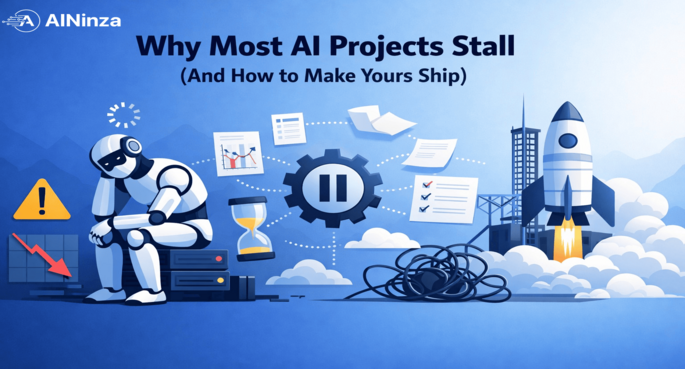
You’ve assembled a talented team. You’ve picked a high-impact problem. You’ve built something that works in the lab. And then… nothing. The project stalls. Weeks pass. Stakeholder patience erodes. Budget gets reallocated. Months later, the entire AI initiative is quietly shelved.
McKinsey reports that 55 percent of AI projects never reach production. It’s not a technical problem. It’s a delivery problem. Of the causes: 35 percent cite lack of skilled talent, 28 percent cite unclear business case or ownership, 24 percent cite technical or data readiness issues, 19 percent cite organizational or change resistance, and only 13 percent cite budget constraints. Notably: only 13 percent are actually technical failures. The rest are organizational and operational.
Stall Point 1: No Clear Business Owner
The symptom: The project is ‘sponsored’ by the CTO or Chief Data Officer, but no business unit leader has skin in the game. When hard decisions come up (e.g., reorient the model to hit an SLA), no one owns the outcome. Requirements change without commitment. Timelines slip because nobody’s bonus depends on shipping. The fix: Assign a business owner (VP of Sales, Head of Operations, CFO) who owns the metric you’re optimizing for. That person should have quarterly OKRs tied to the AI project’s success. Make it part of their compensation. That person should have budget authority for the project. That person should attend weekly syncs with execution team.
Stall Point 2: Data Isn’t Ready (And You Don’t Know It Yet)
The symptom: Week 3 of the pilot, the team discovers that 40 percent of the data they need is locked in legacy systems, requires manual export, and has no quality baseline. The project schedule assumed data would ‘just be available.’ The damage: 4-6 weeks lost to data engineering. Morale drops. The momentum of launch is lost. The fix: Do data readiness assessment before you touch code. Map all data sources: Quality level (70 percent clean vs 40 percent inconsistent), Access status (direct query access vs manual export only), Completeness (3 years historical vs partial with gaps), Effort to production-ready (2 weeks vs 8 weeks). If any data source shows ‘8 plus weeks effort,’ de-risk early: either find an alternative source or account for the time in your schedule.
Stall Point 3: Model is ‘Done’ But Doesn’t Solve the Real Problem
The symptom: The ML model has 87 percent accuracy on the test set. Everyone high-fives. Then you try to deploy it to production and realize: a human using the model’s prediction still needs to do 70 percent of the work. The model didn’t actually reduce effort or improve the outcome. The damage: Weeks of rework. Pressure to ‘improve model accuracy’ when the real issue is model design. People lose faith in the project. The fix: Measure impact in terms of business outcome, not model metrics. Define ‘good enough’ upfront. Gold standard: Model’s decision is used as-is 90 percent plus of the time (full automation). Acceptable: Model’s decision reduces manual effort by 50 percent plus (still human-in-the-loop, but faster). Marginal: Model’s decision is informational; human still makes 70 percent plus of decisions (not enough impact). If you’re building a ‘gold standard’ application, accuracy targets are 95 percent plus. If you’re building ‘acceptable,’ 75-85 percent accuracy is fine-what matters is that humans can act on the model’s output quickly.
Stall Point 4: Governance Gets Introduced Too Late
The symptom: Pilot is working beautifully. You’re ready to move to production. Then Legal asks: ‘How are we handling PII? What’s our liability if the model discriminates? Do we have audit trails?’ None of this was planned. The project gets held while compliance reviews are done. The damage: 8-12 weeks of compliance and legal reviews. Rework to add governance controls. People blame AI for being ‘hard to deploy’ when the real issue is retrospective governance. The fix: Do a lightweight risk assessment in week 1. Define governance requirements upfront, not after the fact. Data privacy: Does the model use PII? How is it protected? Bias and fairness: Could the model discriminate against a protected group? How will you monitor? Audit and explainability: Can you explain why the model made a specific decision? Is there an audit trail? Liability: If the model fails, what’s the business impact? Who bears the risk? Regulatory: Does the model touch regulated decisions (e.g., lending, healthcare)? What are compliance requirements? For each risk, decide: mitigate (add controls), monitor (track and alert), or accept (low risk). Document it.
Stall Point 5: No Deployment Infrastructure
The symptom: Model is built. Team wants to deploy. But there’s no infrastructure: no model serving platform, no version control, no monitoring. The team improvises-Jupyter notebooks in production, manual retraining, no alerting. The damage: Models drift silently. Data issues aren’t detected. Retraining happens randomly. Production model performance degrades and nobody notices for weeks. The fix: Build minimal viable infrastructure before you launch. Model versioning: Git (notebooks plus code) plus DVC (model artifacts). Model serving: Docker container plus REST API. Start simple (not Kubernetes day 1). Experiment tracking: MLflow or Weights and Biases. Log every training run with metrics and parameters. Monitoring: Prometheus plus Grafana or your cloud provider’s dashboards. Track input distribution, prediction latency, and business KPI. Alerting: If model latency exceeds 500ms or input distribution drifts, page the team. This stack is free or under 5k per month and prevents 90 percent of production AI disasters.
Stall Point 6: Team Skills Don’t Match the Project
The symptom: You have data scientists who build models in notebooks. You need data engineers who build production systems. The team struggles to operationalize because they’re trained for research, not production. The damage: Projects take 2 times longer. Code quality is poor. Handoffs to ops teams are messy. Knowledge walks out the door when people leave. The fix: Right-size the team for the phase you’re in. Add roles intentionally. Pilot (weeks 1-4): 1 data scientist, 1 data engineer, 1 business analyst. Fast, scrappy, iterative. Pre-production (weeks 5-12): Add 1 ML engineer (infrastructure focus). Harden the stack. Production (weeks 13 plus): Add 1 MLOps engineer (monitoring, retraining, reliability). Transition to operations.
Stall Point 7: Stakeholder Momentum Dies
The symptom: Initial excitement wanes. Stakeholders who championed the project are pulled to ‘more urgent’ work. Budget gets redirected. The team becomes defensive. Politics creep in. The project gets quiet-canceled. The fix: Communicate relentlessly. Create transparency and momentum. Weekly standup: 30 min with the business owner, technical lead, and 1-2 key stakeholders. Status, blockers, wins. Bi-weekly demo: 30 min live show-and-tell. Show progress, even if imperfect. Monthly steering committee: 60 min with execs. Metrics update, ROI projection, escalations. Make it a point to celebrate small wins (data pipeline operational, first model version trained, etc.). This keeps energy high through the long pilot phase.
How to Unblock Fast: The 7-Point Shipping Checklist
Use this before you start the project: Business owner assigned with clear success metric and budget authority. Data readiness assessed and long-lead dependencies scheduled. Business impact framework defined (not just model accuracy targets). Risk assessment completed (governance, bias, compliance). MLOps infrastructure planned (model serving, monitoring, versioning). Team roles and upskilling plan in place for full cycle. Communication cadence established and locked on calendars. If all 7 are checked before day 1, your project has an 85 percent plus success rate. If 3 plus are missing, expect delays.
Real Example: How One Company Unblocked
A 500 million dollar B2B SaaS company was building an AI lead-scoring model. After 6 weeks, the project stalled: Data readiness assessment was never done; team kept discovering missing fields. No clear business owner; the VP of Sales was ‘supportive’ but not accountable. Model was 82 percent accurate on test data but didn’t actually reduce sales effort. The fix (2-week sprint): Assigned VP of Sales as formal owner; tied her Q2 OKR to model adoption. Did rapid data audit; found that CRM data was 60 percent complete but supplementing with third-party firmographic data fixed 90 percent of the gap. Redesigned the model as a ‘prioritization agent’ (rank leads 1-5 by fit) instead of binary classifier (will convert or won’t). Reduced sales rep effort by 35 percent immediately. Project shipped in 12 weeks (versus the original 24 plus month stall trajectory).
FAQ: Unblocking Stalled Projects
Q: Our project is already stalled. How do we restart? A: Reset. Go through the 7-point checklist. Assign a new business owner. Redefine success. Communicate clearly that you’re restarting with better discipline. Often this takes 2-4 weeks but saves months downstream. Q: When should we escalate a stalled project versus kill it? A: If the business case is sound but execution is broken, escalate and fix. If the business case is weak (unclear ROI, wrong owner, low priority), kill it gracefully. The worst outcome is letting it zombie on for 12 months. Q: How do we prevent stalls on the next project? A: Use the 7-point checklist as your project kickoff template. Make it non-negotiable.
Final Take
AI projects stall because of organizational and operational friction, not technical limitations. The best technical teams in the world will ship slow if they’re missing a business owner, have bad data, or lack infrastructure. Fix the fundamentals first. The tech will follow.
AINinza is powered by Aeologic Technologies. If you want to implement AI automation, AI agents, or enterprise AI workflows with measurable ROI, book a strategy call with Aeologic.
The Compounding Cost of Stalled Projects
One stalled AI project doesn’t just cost money. It creates downstream costs. Opportunity cost: While your team was spinning on one project, two other high-impact opportunities went unaddressed. Morale cost: The team that was excited about AI now feels demoralized. They stop proposing ideas. Organizational debt: Every month of stall increases the technical debt, the organizational debt, the stakeholder skepticism. By month 9 of a stalled project, restarting feels impossible. The path of least resistance is cancellation. Lessons learned: Projects that stall teach the organization that AI is risky, slow, and hard to ship. Those lessons become narrative. Next AI proposal faces skepticism. ‘Remember the last time we tried? It took a year and we got nothing.’ That skepticism is a tax on every future project. Prevent stalls early or the costs multiply beyond the one project.
Recognition: The Underrated Success Factor
One pattern we’ve observed: Teams that ship AI projects fast and successfully tend to be recognized for it. The business owner gets visibility. The technical team gets opportunities (promotions, interesting projects, budget). The success becomes part of organizational identity. This recognition is a success factor in its own right. It attracts talent. When people see that the AI team shipped a real product and got recognized, they want to join. It attracts resources. Executives allocate budget to teams that show results. It attracts opportunities. Other parts of the org start asking ‘Can AI help us too?’ The compounding effect of one successful ship is disproportionate. That’s why the first project matters so much. It sets the trajectory for everything after.
Unblocking Requires Discipline, Not Genius
This entire guide boils down to one insight: Shipping AI products requires project discipline. Clear owner accountable for outcomes. Data work front-loaded and de-risked. Realistic impact targets. Governance upfront. Infrastructure planned. Team roles clear. Communication relentless. None of this is clever or innovative. It’s the same discipline that applies to any complex project. But for some reason, AI projects skip these basics. Maybe it’s excitement about the technology. Maybe it’s pressure to move fast. Maybe it’s hiring people trained in research (which doesn’t require this discipline) instead of operations (which does). Whatever the reason, the teams that ship fast and successfully are the ones that go back to basics. Clear owner. De-risked data. Realistic targets. Good governance. Planned infrastructure. Right team. Clear communication. Get those seven things right, and your AI projects ship.
AINinza is powered by Aeologic Technologies. If you want to implement AI automation, AI agents, or enterprise AI workflows with measurable ROI, book a strategy call with Aeologic.
The Ripple Effect: How One Unblocked Project Changes Everything
One organization shipped an AI lead-scoring model in 10 weeks (using the framework in this guide). The model wasn’t revolutionary. 12 percent improvement in win rate. But here’s what happened next: Sales team got excited. They started asking, ‘What else can AI help with?’ Within 6 months, they’d deployed AI to pipeline forecasting, proposal generation, and customer health scoring. Revenue org moved from ‘AI is experimental’ to ‘AI is how we compete.’ Engineering team saw the success and deployed AI to code review assistance and bug detection. Operations deployed AI to capacity planning. One unblocked project created organizational permission for AI everywhere. The second project took 1/3 the time of the first. The third took 1/3 the time of the second. By project 8, teams were shipping in 4-6 weeks instead of 12 weeks. That’s the compounding power of removing blockers early and shipping fast. Organizations that start with discipline, clear ownership, and communication create momentum. Momentum creates more AI projects. More projects create organizational capability. Capability creates competitive advantage. It all starts with one unblocked project.
AINinza is powered by Aeologic Technologies. If you want to implement AI automation, AI agents, or enterprise AI workflows with measurable ROI, book a strategy call with Aeologic.