The AI Readiness Playbook for Modern Businesses (2026 Edition)

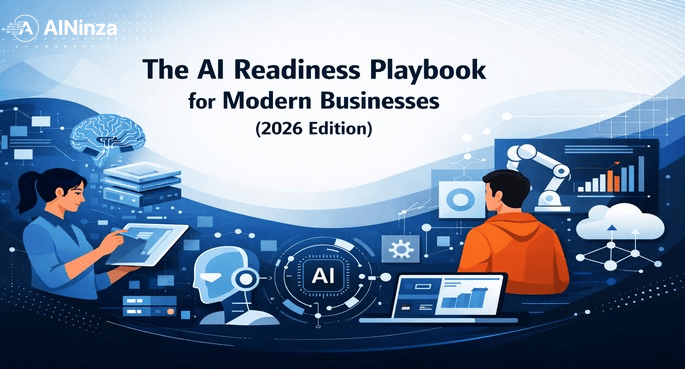
The AI Readiness Playbook for Modern Businesses (2026 Edition)
Most mid-market companies do not have an AI problem. They have an execution problem disguised as an AI strategy discussion.
If your revenue is between $10M and $500M, your board is asking for AI progress, competitors are announcing pilots, and your teams are testing tools on corporate cards. Without a hard operating model, this creates cost, risk, and noise instead of margin improvement.
Here is the blunt version: AI readiness is not about buying licenses. It is about whether your company can move from idea to measurable operating result in under 120 days, repeat that result across functions, and do it without exposing regulated data.
This playbook gives you a scoring framework, maturity model, budget reality, and 90-day execution plans you can run next week.
Part 1: AI readiness scorecard (0-100)
Score your business across four dimensions. Each dimension is 25 points. Total score determines your maturity level and your 90-day plan.
Scoring method
- 0-5: Ad hoc, no standards, hero-driven efforts
- 6-12: Basic controls exist but inconsistent adoption
- 13-19: Repeatable practices in some business units
- 20-25: Company-wide standard with clear ownership and metrics
Readiness assessment criteria by dimension
| Dimension (25 each) | What to assess | How to score | Owner |
|---|---|---|---|
| Organizational | Executive sponsor with budget authority, use-case prioritization process, decision rights, legal/risk sign-off workflow, KPI ownership | 0-5: No owner; 6-12: owner without mandate; 13-19: steering group with partial control; 20-25: operating committee tied to P&L outcomes | CEO/COO + business unit heads |
| Data | Data availability, quality SLAs, master data consistency, access controls, metadata/catalog, retrieval architecture | 0-5: siloed spreadsheets; 6-12: warehouse exists with trust gaps; 13-19: governed domain data; 20-25: trusted enterprise data products with monitored quality | CIO/CDO |
| Infrastructure | Model hosting strategy, integration layer, API management, observability, identity controls, rollback mechanisms, cost monitoring | 0-5: disconnected SaaS experiments; 6-12: basic APIs and SSO; 13-19: shared platform with policy controls; 20-25: production-grade platform with uptime and incident response | CTO/Head of Engineering |
| Talent | AI product management, data engineering capacity, domain SMEs in workflow design, change management, training completion | 0-5: no internal capability; 6-12: few power users; 13-19: cross-functional squad model; 20-25: institutional capability with role-based training and incentives | CHRO + functional leaders |
Interpretation
- 0-25: Do not attempt enterprise AI programs. Fix operating basics first.
- 26-50: Run tightly scoped pilots in one function with strict governance.
- 51-75: Expand to 2-3 departments with common platform standards.
- 76-100: Move to portfolio execution and margin-focused automation at scale.
Part 2: Maturity model (Level 1-5) and what it actually looks like
Level 1: Experimental chaos
Employees use ChatGPT, Copilot, Claude, or niche tools independently. There is no approved use-case list, no data policy, and no outcome tracking. Security discovers AI usage after the fact.
- Symptoms: random subscriptions, shadow prompts with customer data, no measurable ROI
- Business risk: data leakage and wasted spend
- Typical companies: $10M-$40M firms with fast growth and thin IT governance
Level 2: Controlled pilots
Leadership approves 2-5 pilot projects in one business unit. Some policies exist (approved tools, restricted data classes), but integration with core systems is light. Results are promising but fragile.
- Symptoms: decent pilot results, poor repeatability
- Business risk: pilot theater; no scale path
- Typical companies: regional healthcare groups, logistics operators, specialty manufacturers
Level 3: Functional deployment
AI is embedded in at least one critical workflow (for example claims triage, procurement analytics, route planning, or customer support operations). Data pipelines and ownership are defined. Teams can ship use cases every quarter.
- Symptoms: measurable time/cost gains in one or two functions
- Business risk: fragmented tooling across departments increases long-term cost
- Typical companies: $50M-$150M businesses with active IT modernization
Level 4: Cross-functional scale
Shared AI platform standards are in place (identity, logging, prompt controls, model routing, vendor review, legal templates). Multiple departments run on common architecture. Finance tracks AI economics per use case.
- Symptoms: repeatable delivery with defined payback criteria
- Business risk: rising model and inference costs if FinOps discipline is weak
- Typical companies: $150M-$500M firms with active PMO/operations excellence culture
Level 5: AI-native operating model
AI is treated like ERP or CRM: business-critical, governed, measured, and continuously improved. Strategy, budgeting, and talent plans assume AI-assisted work as default. Vendor concentration risk is actively managed.
- Symptoms: portfolio governance, quarterly model/vendor reviews, consistent productivity and quality gains
- Business risk: complacency and over-automation in regulated decisions
- Typical companies: top quartile operators in finance, healthcare operations, and advanced logistics
Part 3: The blockers that kill most AI programs
1) Data silos: your real bottleneck is not model quality
Manufacturing firms often have ERP data in one system, maintenance logs in another, and supplier communications in email. AI cannot reason consistently if source truth is split across disconnected systems.
Hard truth: if you cannot define a trusted source for the top 20 operational metrics, AI deployment should pause.
What to do:
- Stand up a domain-by-domain data product map (sales, operations, finance, service)
- Set quality SLAs for each critical dataset (freshness, completeness, accuracy)
- Adopt a retrieval layer for enterprise knowledge (for example Azure AI Search, Elastic, Pinecone, Weaviate)
2) Skills gaps: your best domain experts are rarely AI-fluent
In healthcare operations, frontline managers know bottlenecks but cannot translate them into workflow specs. Engineering teams can build, but they miss operational nuance. Result: technically sound systems that teams ignore.
What to do:
- Create mixed squads: 1 product owner, 1 domain lead, 1 data engineer, 1 process owner
- Train managers on workflow redesign, not just prompt writing
- Tie adoption targets to leader incentives
3) Unclear ROI expectations: many teams promise magic, then miss simple economics
If a pilot cannot show one of these in 90 days, stop funding:
- 15-25% cycle-time reduction in a high-volume process
- 10-20% reduction in handling cost per transaction
- 5-10% lift in conversion or collections where AI assists reps
Do not accept vague claims such as “better efficiency” without unit economics.
4) Vendor lock-in fears: valid concern, often poorly handled
Financial services teams fear getting trapped in one model ecosystem with rising inference costs. This concern is real. The fix is architecture discipline, not indecision.
What to do:
- Use abstraction frameworks and gateway patterns (LangChain, LlamaIndex, Portkey, custom API layer)
- Separate prompt/application logic from model provider specifics
- Run quarterly dual-vendor benchmark tests for quality and cost
5) Security and compliance concerns: this is where boards will stop your program
Healthcare and finance use cases require auditable controls. You need redaction, access logs, approval workflow for high-risk outputs, and retention policies.
Minimum control stack:
- Identity and access: Okta, Entra ID, or equivalent
- Data loss prevention and monitoring: Microsoft Purview, Nightfall, BigID
- Security posture and policy enforcement in cloud: Wiz, Prisma Cloud
- Model and prompt observability: Langfuse, Arize, WhyLabs
Part 4: What AI actually costs in 2026
Most mid-market leaders underestimate implementation and change costs, then overfocus on model API pricing. Model tokens matter, but integration, governance, and adoption are the bigger line items.
| Initiative scale | Typical scope | 12-month budget range (USD) | Team footprint | Expected payback window |
|---|---|---|---|---|
| Pilot | 1 use case, 1 department, limited integration | $80,000 – $250,000 | 4-6 people (part-time mix) | 6-12 months |
| Department rollout | 3-5 workflows, production integration, governance baseline | $300,000 – $1.2M | 8-15 people | 9-18 months |
| Enterprise program | Multi-function platform, shared controls, portfolio governance | $1.5M – $8M+ | 20-60 people across IT + business | 12-30 months |
Budget composition reality check
- Model/API and compute: 15-30%
- Integration and engineering: 25-40%
- Data cleanup and governance: 15-25%
- Security/compliance controls: 10-20%
- Training and change management: 10-20%
If your plan allocates 70% to model licenses and 5% to adoption, it will fail.
Part 5: Build vs Buy vs Partner decision matrix
Do not turn this into a philosophical debate. Decide by strategic sensitivity, speed requirement, and internal capability.
| Company profile | Recommended path | Why | Examples |
|---|---|---|---|
| $10M-$50M, limited IT team, urgent productivity needs | Buy (70%) + light partner support | Speed beats customization; avoid custom stack burden | Microsoft Copilot, Google Workspace AI, Zendesk AI, UiPath |
| $50M-$200M, moderate tech depth, process-heavy operations | Partner-led build for core workflows + buy commodity tools | Need differentiation in operations while keeping time-to-value reasonable | Custom triage/forecasting on Azure/OpenAI or AWS Bedrock + off-the-shelf copilots |
| $200M-$500M, regulated environment, strong engineering team | Hybrid build with strict vendor portfolio strategy | Control, compliance, and long-term economics matter more than quick pilots | Internal orchestration layer, multi-model routing, domain-specific assistants |
Opinionated rule set
- Buy for generic productivity.
- Build for workflows that affect margin, risk, or customer retention.
- Partner when speed matters and your internal team has execution gaps.
- Never build first if you cannot assign a business owner with quarterly targets.
Part 6: First 90-day action plans by maturity level
Level 1 to Level 2 (Days 1-90): establish control and focus
- Week 1-2: appoint executive sponsor, freeze unapproved AI tools, publish acceptable-use policy
- Week 3-4: shortlist top 10 use cases by value and feasibility; select top 2
- Week 5-8: run pilots with baseline metrics (time per task, error rate, cost per case)
- Week 9-12: board review with continue/kill decision based on measured impact
Target outcome: two controlled pilots with real metrics and legal approval.
Level 2 to Level 3 (Days 1-90): move from pilot to production workflow
- Integrate one pilot into a live system (CRM, ERP, ticketing, or EHR-adjacent process)
- Implement access controls, logging, and exception handling
- Define support model: owner, incident path, retraining cadence
- Set monthly ROI dashboard reviewed by CFO and COO
Target outcome: one production workflow with a stable owner and payback trajectory.
Level 3 to Level 4 (Days 1-90): standardize the platform
- Create shared architecture patterns for prompts, agents, retrieval, and APIs
- Consolidate overlapping vendors; cap duplicate contracts
- Launch AI PMO rhythm: weekly delivery review, monthly risk review
- Start internal academy for managers and process leads
Target outcome: repeatable deployment model across at least 2 functions.
Level 4 to Level 5 (Days 1-90): optimize portfolio economics
- Implement use-case P&L tracking (benefit, run cost, risk exposure)
- Benchmark primary and secondary model providers quarterly
- Expand automation into adjacent functions with proven templates
- Run external audit for compliance and model governance
Target outcome: AI portfolio managed like any other capital allocation program.
Part 7: Industry snapshots — what good execution looks like
Manufacturing
Use case: predictive maintenance + procurement exception handling.
Result pattern: 12-18% reduction in unplanned downtime, 8-12% inventory carrying cost improvement when maintenance and purchasing data are integrated.
Common miss: teams deploy anomaly detection without maintenance process redesign.
Healthcare operations
Use case: prior authorization and denial management support.
Result pattern: 20-35% reduction in manual review time when AI drafts standardized documentation and flags missing clinical evidence.
Common miss: no compliance gate before outbound submission.
Financial services
Use case: onboarding document verification and compliance analyst copilots.
Result pattern: faster account opening and lower rework, with strict human approval checkpoints.
Common miss: over-automating risk decisions that still require human accountability.
Logistics
Use case: dispatch optimization and claims triage from email/PDF inputs.
Result pattern: lower planning time and fewer preventable delays when AI is connected to real-time route and contract data.
Common miss: model outputs are not tied to operational constraints, so planners ignore them.
Field reality: why projects fail after promising pilots
- Pilot owner gets promoted; nobody owns scale-up.
- Data teams are asked to support five pilots with no priority order.
- Legal is called late, then blocks go-live due to contract and data terms.
- Finance approves innovation budget but not integration budget.
- Frontline managers are measured on output volume, not adoption quality.
Fix these five issues and your odds improve fast.
Board-level KPI set you should track monthly
- Adoption: % of target users active weekly in AI-assisted workflows
- Productivity: cycle-time change per process (before/after)
- Quality: error/rework rate and escalation rate
- Economics: run cost per transaction and cumulative benefit
- Risk: policy violations, data incidents, high-risk output overrides
- Delivery: use cases moved from pilot to production per quarter
FAQ for CEOs and operations leaders
How many AI pilots should we run at once?
Two to three maximum for most mid-market firms. More than that fragments your team and delays production outcomes.
Should we hire a Chief AI Officer now?
Not at Level 1 or Level 2. Assign COO/CTO joint ownership first. Add a dedicated AI leader when you have at least three production use cases and clear budget governance.
What is the minimum budget to start responsibly?
Plan at least $80,000 to $150,000 for a serious pilot with integration, security review, and change management. Anything far below that is usually a demo, not an operating program.
Can we rely on a single model provider?
For early pilots, yes. For scale, no. Add portability guardrails by Level 3 to prevent long-term pricing and dependency problems.
What should we refuse to automate?
High-stakes decisions with legal or safety consequences unless human approval remains mandatory and auditable.
References
- McKinsey: The State of AI
- Gartner: Building the business case for AI
- Deloitte: State of AI in the enterprise
- Microsoft Azure AI architecture guidance
- AWS Bedrock platform overview
- Google Vertex AI documentation
- NIST AI Risk Management Framework
- ISO/IEC 42001 AI management systems
- IBM: Cost of a Data Breach Report
Final recommendation
If your AI program is not tied to operating metrics, it is a cost center. Score your readiness this week, pick two high-value workflows, fund integration and governance properly, and run 90-day execution with weekly accountability. Anything else is expensive theater.
AINinza is powered by Aeologic Technologies, helping businesses turn AI plans into production systems that improve margins and execution speed. Learn more at https://aeologic.com/.