AI Transformation Roadmap: From Pilot Chaos to Scalable Execution

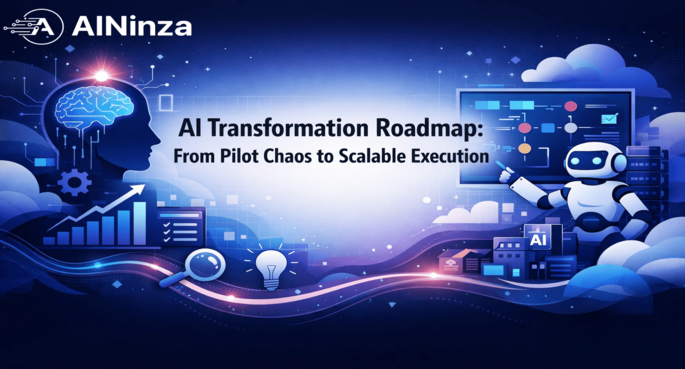
AI Transformation Roadmap: From Pilot Chaos to Scalable Execution
Most organizations launch AI pilots successfully. Then everything breaks. Teams are running isolated experiments, models aren’t talking to each other, governance is ad hoc, and nobody knows which pilot to scale. This is ‘pilot chaos’-and it’s the number one reason AI initiatives stall between proof-of-concept and production.
McKinsey’s 2024 AI adoption survey found that 58 percent of companies with active AI pilots report ‘difficulty scaling pilots to production’. The core issues: No shared infrastructure. Each pilot builds its own data pipeline, model serving, and monitoring. Governance gaps. Pilots are shadowed experiments; moving to production triggers new compliance, audit, and risk requirements that weren’t planned. Team silos. Each business unit’s AI team operates independently. No shared learning, duplicated work. Data fragmentation. Pilots use different data sources, schemas, and quality standards. When you try to combine them, integration costs explode. No clear prioritization. Which pilot should we scale first becomes political. Without a framework, you make bad bets. Forrester’s 2024 research shows organizations with a structured transformation roadmap achieve 3.1 times faster time-to-scale and 2.4 times higher realized ROI.
Phase 1: Assess and Prioritize (Weeks 1-4)
Before you scale anything, map what you have and decide what matters. Step 1a: Pilot Inventory. List every AI pilot in your organization: Business problem it solves, Current data sources and quality, Team and ownership, Technical stack (models, frameworks, infrastructure), Baseline metrics and current performance, Estimated production cost versus expected ROI. Step 1b: Capability Maturity Assessment. Rate your organization against critical AI capabilities. Data governance: Ad hoc (no standards) to Managed (enforced across all pilots). Model versioning and tracking: Ad hoc (models on laptops) to Managed (automated CI/CD, audit trail). Monitoring and observability: Ad hoc (manual spot checks) to Managed (real-time alerting plus automated retraining). Risk and compliance: Ad hoc (per-project assessment) to Managed (automated controls, audit-ready). Step 1c: Strategic Prioritization Matrix. Plot pilots on impact versus complexity. High impact, low complexity: Scale immediately (quick wins). High impact, high complexity: Build reference architecture for this pattern. Low impact, low complexity: Consolidate or sunset. Low impact, high complexity: Sunset; not worth the infrastructure investment. This typically results in: Scale 2-3 pilots, standardize 3-5 patterns, sunset 2-4 experimental projects.
Phase 2: Build Shared Infrastructure (Weeks 4-12)
Now that you’ve prioritized, build the foundation that all scaled pilots will depend on. Step 2a: Data Architecture. Establish a centralized data layer that feeds all AI applications. Data lakehouse: Single source of truth for structured and unstructured data. Feature store: Standardized, reusable feature definitions and computations (reduces duplicated ETL). Data governance: Metadata tagging, lineage tracking, access controls, quality monitoring. Gartner’s 2024 data platform research shows organizations with centralized data layers realize 35 percent faster model iteration and 45 percent lower total cost of ownership. Step 2b: Model Serving Infrastructure. Build a shared platform for deploying, versioning, and monitoring models. Model registry: Track all versions, performance metrics, and deployment status. Inference service: Unified API for serving models (batch plus real-time). A/B testing framework: Safely test new model versions in production. Fallback or circuit breaker: Automatic rollback if model performance degrades. Step 2c: Observability and Monitoring. Define shared KPIs and set up real-time dashboards. Model health: Prediction latency, inference cost, cache hit rate. Business impact: Revenue, cost savings, user satisfaction metrics tied to the model. Data quality: Input distribution drift, missing values, schema changes. Fairness and bias: Model performance across demographic groups and edge cases. Step 2d: Governance and Compliance Layer. Build controls for risk and audit readiness. Risk assessment framework: Template for evaluating bias, privacy, regulatory risk per model. Explainability tools: SHAP, LIME, or similar for model decision attribution. Audit trail: Immutable log of model changes, deployments, and decisions (required for regulated industries). Access controls: Role-based permissions for data, models, and production systems.
Phase 3: Scale Pilots with Governance (Weeks 12-24)
Use the shared infrastructure to scale your 2-3 priority pilots from pilot to production. Pilot to Production Checklist: Migrated to shared data layer, Data quality baseline established and monitored, Model registered in model registry, All versions plus metrics tracked, Deployed to shared inference platform, Real-time plus batch serving working, Observability configured, Business metrics plus model health dashboards live, Risk assessment completed, Bias, fairness, and regulatory checks documented, Explainability implemented, Stakeholders can understand model decisions, Governance approved, Data governance board signed off on data usage plus controls, Production runbook created, Team trained on monitoring, escalation, rollback, SLA defined, Uptime, latency, and accuracy commitments documented. Staged Rollout Pattern: Week 1-2 at 5 percent of traffic, monitor for exceptions. Week 3-4 at 25 percent of traffic, validate business impact. Week 5-6 at 50 percent of traffic, stress test infrastructure. Week 7 plus at 100 percent traffic, full production. At each gate, a decision: proceed, iterate and relaunch, or rollback.
Phase 4: Optimize and Replicate (Weeks 24 plus)
Once you’ve scaled 2-3 successful pilots, the pattern repeats faster. Step 4a: Build a Playbook. Document the pattern: ‘How we move AI from pilot to scale at Company X.’ Feature engineering template, Data quality standards, Model evaluation framework, Deployment checklist, Monitoring dashboard template. Step 4b: Establish an AI Center of Excellence. Create a center of excellence (COE) that owns infrastructure, standards, and knowledge sharing. Platform team: Maintains shared data, model serving, and observability infrastructure. Enablement team: Trains business units on the playbook, helps pilot teams scale. Governance board: Reviews all AI projects for risk, compliance, and alignment. Step 4c: Measure Program ROI. Track metrics across all scaled pilots: Total AI-driven revenue and cost savings, Time from pilot to scale (target: less than 6 months), Cost per scaled pilot (should decrease over time as playbook matures), Adoption rate by business unit.
Common Roadmap Mistakes
Mistake 1: Scaling Before Standardizing. Scaling a pilot with inconsistent data formats, governance, and monitoring into production doesn’t make it repeatable-it makes it a debt. Establish standards first. Mistake 2: Ignoring Organizational Change. New infrastructure requires new skills, new roles, and new processes. Invest in training and hire or upskill data engineers, MLOps specialists, and governance leads. Bain research shows organizations that invest in change management see 2.3 times better adoption rates. Mistake 3: No Clear Governance Early. Pilots operate in the shadows. Moving to production triggers compliance, risk, and audit requirements that derail projects. Define governance up front; don’t retrofit it. Mistake 4: Building Custom Infrastructure. Temptation: build a custom data platform, custom model serving layer, custom monitoring. Reality: this adds 12-18 months and 500k to 2M in overhead. Use managed services or proven open-source stacks.
Timeline and Investment
Assess and Prioritize: 1 month, 50k to 100k. Build Shared Infrastructure: 2-3 months, 150k to 300k. Scale Pilots: 3 months, 100k to 200k per pilot. Optimize and Replicate: Ongoing, 50k to 100k per month. Total investment to reach mature, scalable state: 400k to 700k plus 6-9 months. For context: McKinsey data shows the ROI payoff at scale is 5-10 times this investment annually, making it one of the highest-ROI infrastructure investments your organization can make.
FAQ: AI Transformation Roadmap
Q: Do we need a data lakehouse to scale AI? A: Not technically, but practically yes. Lakehouse architectures reduce data integration cost and accelerate new pilots by 60-70 percent. The alternative-point-to-point integrations-becomes untenable at scale. Q: How do we avoid pilot burnout? A: Limit to 2-3 concurrent scaling efforts. More than that, and teams get stretched. Once a pilot ships to production, that’s a success; celebrate it and move to the next. Q: What if our organization isn’t ready for a COE? A: Start with a platform team (3-4 engineers plus 1 governance lead) instead. As the program grows, split into specialized COE functions.
Final Take
Pilot chaos is solved by making transformation predictable and repeatable. Build shared infrastructure, establish governance early, scale pilots in sequence with staged rollouts, and document what works. By month 6, you’ll have shifted from isolated experiments to a coordinated AI operating system.
AINinza is powered by Aeologic Technologies. If you want to implement AI automation, AI agents, or enterprise AI workflows with measurable ROI, book a strategy call with Aeologic.
Practical Governance in Practice: A 6-Month Transformation
Building shared infrastructure sounds abstract. Here’s what it looks like in month-by-month reality. Month 1: Assess pilots. List existing systems. Evaluate capability maturity. Identify quick wins vs long-term bets. Month 2: Start data lake setup. Deploy a managed data platform (Databricks, Snowflake, BigQuery). Set up initial tables and schemas. Establish data governance policies. Begin documenting data lineage. Month 3: Build model serving platform. Deploy MLflow or Sagemaker. Set up experiment tracking. Create first model registry. Month 4: Implement observability. Deploy monitoring for 2-3 pilots. Set up dashboards for business metrics plus model health. Create alert rules. Month 5: Scale first two pilots. Migrate to shared infrastructure. Validate performance. Run staged rollout. Month 6: Reflect and document. Capture what worked. Update playbooks. Plan next wave of pilots. The investment across these 6 months is typically 400k-700k for a mid-sized organization. The returns begin in month 4 and compound from there.
Organizational Change: The Hidden Cost
Building infrastructure is hard. Changing how people work is harder. When you move from siloed pilots to shared infrastructure, you’re asking teams to give up autonomy. The data engineer who built a custom ETL pipeline for their pilot is being asked to use the shared feature store. The data scientist who had full control of their model registry is now operating under governance policies. Resistance is natural. Address it directly. Identify team leads early. Train them. Make them advocates, not subjects. Give them influence in designing the shared platform. Celebrate the first team that successfully migrates to shared infrastructure. Publicize the time and cost savings. Overcome inertia with visibility and peer pressure (the good kind).
When to Build vs Buy vs Open-Source
Shared infrastructure can be built three ways. Buy: Managed data platforms, model serving services, monitoring solutions. Pro: Vendor handles scaling and updates. Con: Less customization, ongoing costs. Build custom: Invest engineering time in bespoke platforms. Pro: Full control. Con: Takes 12-18 months, requires top engineering talent, becomes technical debt quickly. Open source: Use community tools (Apache Airflow, MLflow, Prometheus). Pro: Flexible, no licensing costs. Con: Requires operational expertise, less commercial support. The best approach for most organizations: Mix. Buy managed data platforms (data lakehouse), use open-source for orchestration and monitoring, build custom only for competitive differentiation. This balances speed, cost, and control.
AINinza is powered by Aeologic Technologies. If you want to implement AI automation, AI agents, or enterprise AI workflows with measurable ROI, book a strategy call with Aeologic.
Common Pitfall: Prioritizing Technology Over Organizational Change
Organizations often ask: What’s the best data platform for AI? Should we use open source or commercial tools? How do we structure the data lake? These are legitimate questions. But here’s the truth: Your choice of technology matters less than your choice of process. Teams using basic tools with good process beat teams using best-in-class tools with no process every single time. The second pitfall: Believing that building shared infrastructure will happen automatically. It won’t. It requires active leadership, budget allocation, and people dedicated to the platform team. If you don’t fund a platform team explicitly, it won’t exist. You’ll end up with five mini-platforms built by five different pilot teams. Invest in the unglamorous work: data pipelines, monitoring, governance. This is where scaling success is actually built.
AINinza is powered by Aeologic Technologies. If you want to implement AI automation, AI agents, or enterprise AI workflows with measurable ROI, book a strategy call with Aeologic.
AINinza is powered by Aeologic Technologies. If you want to implement AI automation, AI agents, or enterprise AI workflows with measurable ROI, book a strategy call with Aeologic.