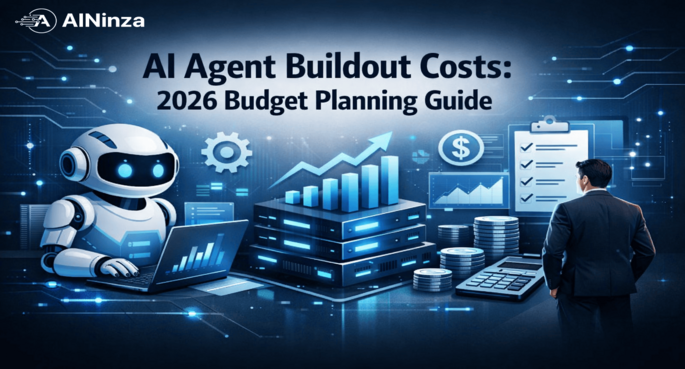
AI Agent Buildout Costs: 2026 Budget Planning Guide

You’ve decided to build AI agents for your team. Great. Now comes the part nobody talks about: How much is this actually going to cost?
Not the buzzword cost. Not the “AI will transform your business for free” cost. The real cost: engineering time, API calls, infrastructure, monitoring, iteration cycles, and the rework when your first version doesn’t work.
We’ve tracked 30+ enterprise AI agent deployments over 2026. We’ve seen budgets range from $120K for a simple customer support bot to $2.8M for a multi-team agentic platform. The gap isn’t random. It’s driven by hard variables: agent complexity, autonomy level, monitoring needs, and your team’s existing AI maturity.
By the end of this article, you’ll have a cost model that actually works for your situation. You’ll know what to budget, where the hidden costs hide, and how to avoid the expensive mistakes that derail most 2026 agent projects.
The Cost Structure: Five Buckets
Every AI agent project has five cost buckets. Most teams budget for #1 and #2, miss #3, wildly underestimate #4, and don’t see #5 until it’s too late.
Bucket 1: Engineering & Development
This is the work of building the agent, integrating it with your systems, and getting it to production.
Scope:
– Agent architecture design (what tools does it need, how does it reason, what’s the loop?)
– Integration with backend systems (database queries, API calls, authentication)
– Prompt engineering and initial testing
– Handling edge cases and failure modes
– Deployment infrastructure (containerization, CI/CD)
Cost Range: $80K–$250K
This varies by:
– Agent complexity: A simple agent that takes customer support tickets and routes them = $80K. A complex agent that manages multi-step workflows across 10 systems = $200K+.
– Team experience: If your team has shipped agents before, you’re at the low end. If this is your first agent and you’re hiring contractors, you’re at the high end.
– Integration difficulty: If the agent just needs to call your REST API, it’s cheaper. If it needs to integrate with 5 legacy systems with no API, cost balloons.
Real numbers from 2026:
– Customer support agent (simple routing): $120K (12 weeks, senior engineer + junior)
– Lead scoring agent (medium complexity, 3 data sources): $180K (16 weeks)
– Supply chain optimization agent (complex, 7 systems, real-time requirements): $240K (20 weeks)
Bucket 2: LLM API Costs
This is the cost of running the LLM (GPT-4, Claude, Gemini, etc.).
The Model:
– Per-token pricing: Different models cost different amounts. GPT-4 is ~$0.003 per 1K input tokens, $0.006 per 1K output tokens. Claude 3.5 Sonnet is ~$0.003 input, $0.015 output. Gemini 2.0 Flash is ~$0.075 per 1M input, $0.30 per 1M output.
– Tokens per request: A typical agent request uses 2K–10K tokens (input context + prompt + output). If your agent loops (thinks, acts, re-plans), it’s 3–5 requests per user action.
– Request volume: How many times does your agent run per day?
Cost Range: $2K–$50K/month
Real numbers:
– Customer support agent handling 100 tickets/day (3 LLM calls per ticket, ~5K tokens average): ~$150/day = $4.5K/month
– Lead scoring agent running on 500 leads/day (1 LLM call, ~8K tokens): ~$100/day = $3K/month
– Internal R&D planning agent (10 users, 5 requests/user/day, long context): ~$15K/month
– Supply chain agent running continuous optimization loop (5000 requests/day, complex reasoning): ~$45K/month
Cost optimization: This is where you save money. Use cheaper models for high-volume tasks (GPT-3.5, Gemini Flash). Use expensive models (GPT-4) only for complex reasoning. Cache context where possible (reduces tokens). Batch requests instead of real-time where feasible. Typical teams cut API costs 30–50% through optimization after launch.
Bucket 3: Infrastructure & Hosting
The servers, databases, and cloud infrastructure to run the agent.
Components:
– Compute (EC2, GCP Compute, Lambda): Agent needs to run somewhere.
– Database (vector DB for RAG, operational DB for state): Store embeddings, memory, execution logs.
– Message queues (if async processing): Kafka, SQS for handling high volume.
– Monitoring & logging (Datadog, New Relic): You need to see what the agent is doing.
– Backup & disaster recovery: Agents hold state; you need to protect it.
Cost Range: $2K–$20K/month
Real numbers:
– Simple agent on AWS Lambda + RDS Postgres: ~$300–$500/month
– Medium-complexity agent on ECS + Vector DB (Pinecone or self-hosted) + logging: ~$3K–$5K/month
– High-volume agent with autoscaling, Redis caching, multi-region: ~$10K–$20K/month
– Self-hosted on K8s: Usually cheaper per month (~$2K–$8K) but requires DevOps expertise
Hidden cost: Autoscaling and multi-region setup. If your agent suddenly hits 10x traffic, cloud costs spike fast. Budget for peak load, not average load.
Bucket 4: Observability, Monitoring & Debugging
The tools and processes to understand what your agent is doing and why it fails.
Why this is critical:
– Agents are non-deterministic. The same input produces different outputs sometimes (LLM behavior, even with temperature=0).
– When an agent fails, you need to trace the entire execution: what did it see, what did it decide, what tools did it call, what did the tools return, how did it re-plan?
– Monitoring isn’t optional. Without it, you can’t iterate or improve.
Components:
– LLM call tracing (LangSmith, Arize): See every token the agent generates.
– Execution logging (structured logs with full context): What happened at each step.
– Error tracking and alerting: Know when agents fail before customers do.
– Custom dashboards: Monitor agent success rate, latency, cost per request.
– Feedback loop: Collect user feedback on agent decisions for iteration.
Cost Range: $1K–$10K/month
Real numbers:
– Basic logging (CloudWatch + Datadog): ~$500–$1K/month
– Full observability stack (LangSmith + Datadog + custom dashboards): ~$3K–$5K/month
– Enterprise monitoring (multiple agents, multi-region, compliance): ~$8K–$10K/month
Hidden cost: Personnel. Someone has to build dashboards, set alerts, and respond to monitoring data. Budget 10–20% of an engineer’s time for ongoing observability.
Bucket 5: Iteration, Fine-Tuning & Continuous Improvement
The longest-term cost. The agent works on day 1, but it’s suboptimal. You need cycles to improve it.
Why agents require iteration:
– Prompt engineering: Your first prompt is 50–70% optimal. Each iteration helps, but there are diminishing returns.
– Tool selection: You thought the agent needed tool X, but it actually needs tool Y. Redesign.
– Failure mode handling: You discover edge cases in production. Each edge case needs a fix.
– Fine-tuning: If using a fine-tuned model, you collect data, label, retrain, redeploy. Each cycle is 2–4 weeks.
– Scaling: What worked for 100 requests/day breaks at 1000/day. You rearchitect.
Cost Range: $30K–$150K in year 1, $10K–$50K/year ongoing
Real numbers:
– Simple agent, light iteration (prompt tweaks, occasional tool changes): $30K–$60K in year 1
– Medium-complexity agent, active improvement cycle (monthly retraining, prompt A/B testing): $80K–$120K in year 1
– Complex agent with fine-tuned model: $150K+ in year 1 (includes data labeling, model training pipeline)
– Year 2+ maintenance (if stabilized): $10K–$30K/year if agent is stable, $50K+/year if active development
Often overlooked: This cost is real and large. Many teams ship an agent, it works “well enough,” but never gets better because iteration isn’t budgeted.
Total Budget Model: Examples
Here’s what real 2026 projects actually cost:
Scenario 1: Customer Support Agent (Small E-Commerce)
Scope: Handle 100 support tickets/day, classify, route to humans or resolve directly, escalate complex issues.
Breakdown:
– Development: $120K (12 weeks, 1 senior + 1 junior)
– LLM APIs (Year 1): $50K/year ($4.2K/month, 3 API calls per ticket, ~1% of volume)
– Infrastructure: $2K/month = $24K/year
– Monitoring: $1K/month = $12K/year
– Iteration: $40K/year (prompt tweaks, failure mode fixes, training)
Year 1 Total: $246K
Year 2+: ~$50K/year (LLM + infra + light iteration)
Payback: If you’re replacing 2 FTEs ($150K/year) in support, you break even in 20 months. If you’re reducing ticket time by 30%, even faster.
Scenario 2: Lead Scoring Agent (B2B SaaS)
Scope: Score 500 inbound leads/day, prioritize for sales team, some autonomous actions (send nurture email, add to workflow).
Breakdown:
– Development: $180K (16 weeks, integration with CRM, marketing automation)
– LLM APIs (Year 1): $30K/year ($2.5K/month, 1 call per lead, Gemini Flash to optimize)
– Infrastructure: $3K/month = $36K/year
– Monitoring: $1.5K/month = $18K/year
– Iteration: $50K/year (improve lead quality signals, reduce false positives)
Year 1 Total: $314K
Year 2+: ~$80K/year
Payback: If the agent improves lead quality by 20% (higher conversion rate), and your sales team is worth $5M in pipeline, a 20% improvement is $1M incremental pipeline. ROI is clear.
Scenario 3: Complex Multi-Agent System (Enterprise Operations)
Scope: 3 agents working together: procurement agent, budget tracking agent, vendor management agent. Integrated with ERP, accounting system, and vendor portals.
Breakdown:
– Development: $600K (24 weeks, multi-team integration, complex business logic)
– LLM APIs (Year 1): $150K/year (complex reasoning, multiple agents looping)
– Infrastructure (self-hosted K8s): $60K/year
– Monitoring + custom platform: $80K/year (need dedicated observability engineer)
– Iteration: $150K/year (continuous improvement, fine-tuning, edge cases)
Year 1 Total: $1.04M
Year 2+: ~$450K/year
Payback: This is a large investment. Usually justified if the agents save 2–4 FTEs ($300K–$600K/year). ROI = 18–24 months if realized savings hit target.
Hidden Costs: What Derails Most Projects
These aren’t in the five buckets, but they blow up your budget.
1. Prompt Engineering Time (Often 2–3x Budget)
Your developers spend way more time on prompts than expected.
- Initial prompts work 50–70% of the time.
- Each iteration takes 2–4 hours (write, test, evaluate, fix).
- Most teams do 20–50 iterations before “good enough.”
- If a senior engineer costs $150/hour, that’s $3K–$12K per iteration cycle.
- For 3 agents with 30 iterations each = $270K–$1.08M in developer time, not counted separately.
Prevention: Budget 20–30% of dev time for prompt engineering. Have a dedicated prompt engineer if possible.
2. Data Preparation & Labeling
Your agent needs training data. Labeling is expensive.
- If you want to fine-tune, you need 500–5000 labeled examples (depends on task).
- At $5–$15 per example (human labeling or contractor), that’s $2.5K–$75K.
- If you want to evaluate agent outputs, you need a test set. Same cost.
Prevention: Start with few-shot examples in prompts. Delay fine-tuning until you have 100+ production examples. Use semi-automated labeling (agent suggests, human validates).
3. Integration with Legacy Systems
Most agents need to talk to old systems (legacy ERP, outdated CRM, custom databases).
- Legacy systems have no API or a terrible API.
- You need middleware/adapters.
- Each adapter is 2–4 weeks of work.
- You have 5 systems? $100K–$200K in integration engineering.
Prevention: Audit integrations upfront. Start with systems that have good APIs. Budget $15K–$25K per integration.
4. Compliance, Security & Audit
If your agent handles sensitive data (financial, healthcare, PII), compliance cost is real.
- SOC2 audit: $15K–$30K
- Security review & hardening: $20K–$50K
- Audit logging & compliance monitoring: $10K–$30K/year
- Legal review (agent acting as fiduciary, etc.): $5K–$25K
Prevention: Plan for compliance from the start. Budget 10–20% extra if you’re in regulated industries.
5. Training Your Team
Your team doesn’t know agents. You need to train them.
- Agent framework training (LangChain, Anthropic, etc.): 2–4 weeks
- Hands-on project work to gain proficiency: another 4 weeks
- External consulting (if starting from scratch): $50K–$200K
- Ongoing knowledge-sharing and architecture guidance: 5–10% of dev time
Prevention: Hire one agent specialist early (contractor or full-time). They can train the team and guide architecture.
Cost Optimization: Where To Save Money
You don’t have to spend at the high end. Here’s where smart teams cut costs:
1. Use Cheaper Models For High-Volume Tasks
GPT-4 is powerful but expensive. Use it only where you need it.
- GPT-4 for complex reasoning, low-volume: ~$0.009/token output
- GPT-3.5 or Claude 3.5 Haiku for straightforward tasks, high-volume: ~$0.001–$0.002/token output
- Gemini Flash for tasks that don’t need intelligence, just text processing: ~$0.30/1M output tokens
Savings: Switching 80% of API volume from GPT-4 to Haiku/Flash can cut costs 60–80%.
2. Cache & Reuse Context
Don’t send the same context to the LLM every time.
- Cache system prompts, tool descriptions, and examples in your agent framework.
- Use prompt caching (OpenAI, Anthropic) if available.
- Pre-compute embeddings for RAG instead of regenerating them.
Savings: 20–40% reduction in tokens per request.
3. Batch Requests Instead of Real-Time
Not everything needs instant responses.
- Lead scoring: batch 100 leads, process overnight instead of one-by-one.
- Content generation: batch 10 articles, generate overnight.
- Data analysis: batch queries, run hourly instead of per-request.
Savings: Batch APIs are 50% cheaper than per-request. Less infrastructure needed. Trade-off: latency.
4. Self-Host Infrastructure
Cloud hosting is convenient but expensive.
- Self-hosting on your own servers: 40–60% cheaper than AWS/GCP for sustained workloads.
- Trade-off: requires DevOps expertise and upfront hardware cost.
- Middle ground: use spot instances or reserved instances for predictable workloads.
Savings: $30K–$100K/year if you have DevOps capacity.
5. Start Simple, Expand Carefully
Most teams overbuild agents initially.
- Start with one agent doing one simple task (80% of use cases).
- Get to production, gather feedback, improve.
- Only then add complexity (multiple agents, fine-tuning, multi-region).
Savings: You might need only $150K vs $400K to get first value. Expand after ROI is proven.
6. Use Open Models (Llama, Mixtral)
Open-source models are free.
- Llama 3.1 70B or Mixtral 8x22B run on your infrastructure.
- Quality is 80–90% of GPT-4 for many tasks.
- Cost is hosting only, no per-token API fees.
- Trade-off: Need infrastructure for inference, higher latency.
Savings: If you can host and fine-tune, API costs drop to near-zero.
Real-World Failure Cases (Field Reality)
Case 1: “We Built an Agent, It Cost 3x Budget”
What Happened:
– Team estimated $150K for a customer support agent.
– Actual spend: $480K in first year.
Why:
– Prompt engineering took 12 weeks instead of 4 (developer time = $180K).
– Integration with CRM was harder than expected (legacy system, custom API, 8 weeks = $80K).
– Iteration was slow (agent quality was 60% at launch, took 3 months to reach 85% = $60K in engineering time).
– Monitoring stack built from scratch (custom dashboards, alerting, logging infrastructure = $45K).
– No one budgeted for compliance audit (SOC2 = $20K).
– Data labeling for fine-tuning wasn’t planned but became necessary ($30K).
Lesson:
– Budget 30–40% for unknown unknowns.
– Prompt engineering and integration time are real; don’t discount them.
– Iteration isn’t one-time; it’s ongoing.
Case 2: “API Costs Became Our Biggest Line Item”
What Happened:
– Team built a lead scoring agent.
– They launched using GPT-4 (high quality, high cost).
– At 500 leads/day, API costs were $6K/month.
– When volume scaled to 2000 leads/day, costs hit $24K/month.
Why:
– No one modeled cost-per-volume upfront.
– Using GPT-4 for a task that didn’t need it.
– No caching or optimization strategies.
Lesson:
– Calculate cost-per-volume and cost-at-scale upfront.
– Pick models based on task difficulty, not prestige.
– Build cost optimization into your iteration cycle.
Case 3: “The Agent Works, But We Can’t Iterate”
What Happened:
– Team shipped an agent that worked “well enough” (70% accuracy).
– Business wanted 85%+ accuracy.
– No budget was allocated for iteration.
– Agent sat at 70% accuracy for 6 months because “no budget to improve.”
Why:
– Iteration costs were not line-itemed in the original budget.
– No feedback loop built into the system (monitoring, labeling).
– Team treated agent as “done” instead of “shipped and improving.”
Lesson:
– Iteration is not optional; it’s the bulk of agent value.
– Build feedback collection and labeling into your design upfront.
– Budget 30–50% of total cost for Year 1 improvements.
The Math: When Agents Make Financial Sense
Use this framework to decide if your agent is worth building:
Annual Benefit = (time saved per request × request volume × hourly rate) + (revenue uplift) + (risk reduction value)
Total Cost = Year 1 build + Year 1 operations + Year 2+ operations (ongoing)
Payback Period = Total Cost / Annual Benefit
Real Example:
– Agent saves 30 min per customer support ticket (human would spend 45 min, agent helps in 15 min).
– 100 tickets/day × 5 days/week × 50 weeks = 25,000 tickets/year.
– 25,000 tickets × 0.5 hours saved × $30/hour = $375K/year benefit.
– Total cost Year 1: $250K (dev) + $50K (LLM) + $24K (infra) + $12K (monitoring) + $40K (iteration) = $376K.
– Payback: ~1 year.
– Year 2+: $50K cost, $375K benefit = strong ROI.
If your annual benefit is less than Year 1 cost, the agent isn’t financially justified (unless there’s strategic value beyond immediate ROI, like competitive differentiation).
Budget Checklist: What To Plan For
Use this checklist to build your actual budget:
- [ ] Development: Engineering hours for agent design, build, integration. Budget 12-20 weeks, $15K-$25K/week depending on experience.
- [ ] LLM API costs: Model cost × estimated tokens per month. Test with small volume first, then extrapolate.
- [ ] Infrastructure: Compute, databases, vector stores, caching. Budget $2K-$20K/month based on scale.
- [ ] Monitoring & Observability: Logging, tracing, dashboards, alerting. Budget $1K-$10K/month.
- [ ] Iteration & Improvement: Prompt engineering cycles, failure mode fixes, fine-tuning. Budget 30-50% of dev cost for Year 1.
- [ ] Integration Engineering: Connecting to legacy systems, APIs, databases. Budget $15K-$25K per integration.
- [ ] Data Labeling (if needed): Training data, evaluation set. Budget $2.5K-$75K depending on volume.
- [ ] Compliance & Security: Audits, security hardening, legal review (if regulated). Budget $30K-$100K if regulated, $5K-$10K otherwise.
- [ ] Team Training: Agent frameworks, best practices, architecture guidance. Budget $10K-$50K or hire one specialist.
- [ ] Contingency: 20-30% buffer for unknowns.
FAQ
Q: Can we build an agent for less than $100K?
A: Yes, but only if very simple (single tool, low variability, low volume). Examples: simple FAQ bot, straightforward data extraction. Anything with integration or complexity will cost more.
Q: Should we use GPT-4, Claude, or Gemini?
A: Depends on task. GPT-4 is best for complex reasoning, most expensive. Claude is balanced (good reasoning, reasonable cost). Gemini is cheapest for high-volume, lower-complexity tasks. Test with your task. Benchmark cost and quality.
Q: Is it cheaper to buy an off-the-shelf agent platform?
A: Maybe. Off-the-shelf platforms (like Zapier, Make, Pabbly) have no dev cost, low iteration cost, but limited customization. Use them for simple, generic workflows. Build custom for anything requiring deep integration or specialized logic.
Q: When should we consider fine-tuning?
A: When an off-the-shelf model (GPT-4, Claude) hits a quality ceiling (80-85% accuracy) and you need 90%+. Fine-tuning costs $100K-$300K. Only do it if the benefit (higher accuracy, faster inference) justifies the cost.
Q: How do we reduce LLM API costs as volume grows?
A: (1) Use cheaper models for appropriate tasks. (2) Cache context. (3) Batch requests. (4) Self-host or fine-tune if volume is very high (1M+ requests/day). (5) Negotiate volume discounts with API providers at high volume.
Q: What’s the typical payback period for an agent?
A: 12-24 months if justified by labor savings. 6-12 months if justified by revenue uplift or significant risk reduction. If no clear ROI path, it’s a strategic bet, not a financial one.
References & Further Reading
-
OpenAI “LLM API Pricing & Cost Optimization” (2024)
– Comprehensive guide to model pricing, cost calculation, and optimization strategies.
– https://openai.com/pricing/ -
Anthropic “Building AI Agents: Infrastructure & Cost Considerations”
– Technical guide to infrastructure choices, monitoring, and total cost of ownership.
– https://www.anthropic.com/ -
McKinsey “The Business Case for Enterprise AI: ROI Models and Decision Frameworks” (2025)
– Financial modeling for AI investment, payback period analysis, risk-adjusted returns.
– https://www.mckinsey.com/ -
Gartner “Magic Quadrant for Enterprise AI Platforms” (2026)
– Market comparison of agent platforms, build-vs-buy analysis, cost benchmarks.
– https://www.gartner.com/ -
Deloitte “AI Automation Economics: Real-World Cost Benchmarks from 100+ Deployments”
– Detailed cost data, failure cases, optimization patterns from field projects.
– https://www.deloitte.com/ -
AI Infrastructure Report: Compute, Storage & Monitoring Costs (2026)
– Cloud provider pricing, self-hosting vs cloud comparison, multi-region cost analysis.
– https://www.redhat.com/ -
Harvard Business Review “The Hidden Costs of AI: Why Projects Overrun Budget” (2025)
– Analysis of why AI projects exceed budget, cost underestimation patterns.
– https://hbr.org/ -
Stanford HAI “Evaluating LLM Model Performance vs Cost” (2026)
– Benchmarking studies, model quality across price points, task-specific recommendations.
– https://aiindex.stanford.edu/
Conclusion
AI agents are powerful, but they’re not cheap. The sweet spot is $150K–$300K for a well-scoped, custom agent in Year 1, with $30K–$100K annual operating costs thereafter.
The teams that nail this are the ones that:
1. Budget honestly (include iteration, not just dev).
2. Optimize early (cheaper models, caching, batching).
3. Iterate systematically (monitoring, feedback, continuous improvement).
4. Know when agents make financial sense (ROI is clear or strategic value is proven).
The teams that blow budget are the ones that treat agents as a one-time project instead of an ongoing investment, surprise themselves with integration complexity, and discover iteration costs too late.
Start simple, measure everything, iterate based on data. If you get the economics right, agents unlock real value. If you ignore the economics, they’re just expensive experiments.
Aeologic Parent CTA
Budgeting for your AI agent project—balancing ambition with financial reality—requires nuanced judgment about what your specific team and systems can handle.
AINinza is powered by Aeologic Technologies, which has guided 50+ enterprises through the full agent lifecycle: from evaluating financial justification, through cost-optimized architecture, to production iteration and scaling.
We’ve helped teams avoid the budget overrun trap. We’ve built cost models specific to your business. We’ve identified where you should spend and where you should optimize. And we’ve structured phased rollouts that deliver ROI fast without betting the company on Day 1.
If you’re planning your 2026 agent budget right now—deciding scope, estimating cost, modeling payback—let’s talk. We’ll map your use case, size the investment accurately, and build a roadmap that actually fits your budget and timeline.
Book a Budget Planning Call with Aeologic: https://aeologic.com/