
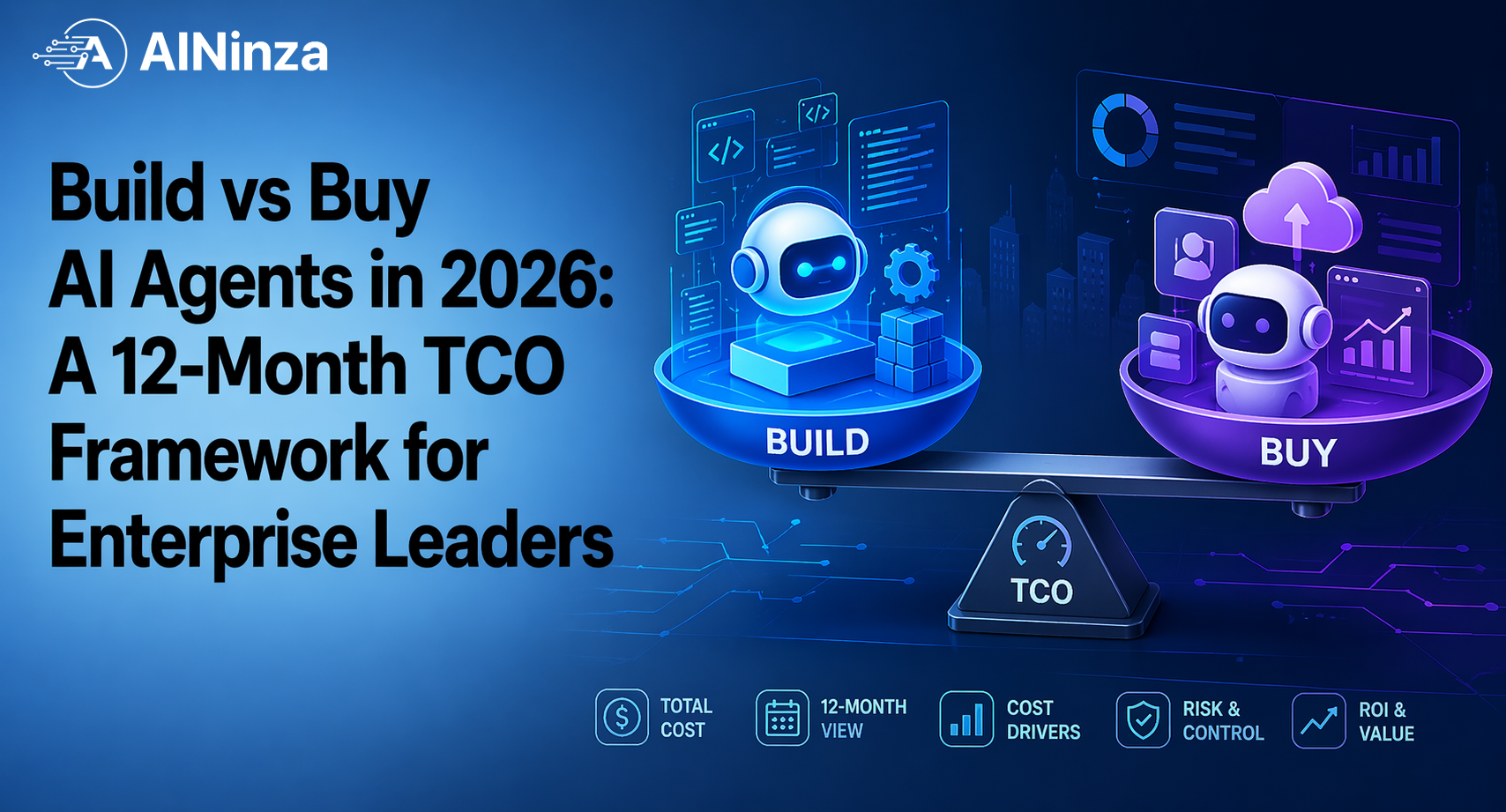
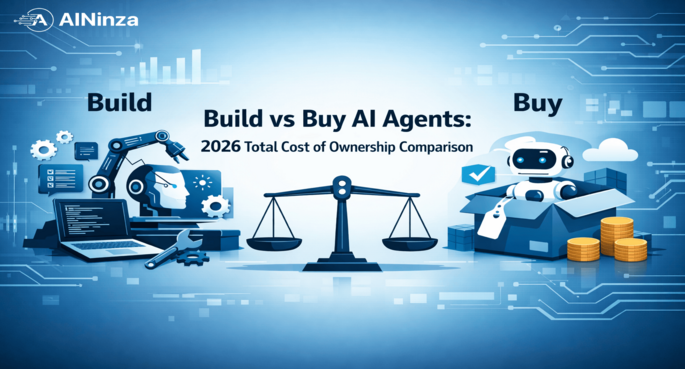
Build vs Buy AI Agents: 2026 Total Cost of Ownership Comparison

Your CTO just sent you three quotes: $45K/month for a managed AI agent platform, $280K for a six-month custom build, $120K to license an off-shelf solution that “mostly” fits your workflow. Your CEO asks the only question that matters: Which one gives us the best ROI by Q3 2026?
This is the decision that’s paralyzing enterprise teams right now. AI agents are no longer theoretical—they’re shipping. But the cost structures are murky, the hidden expenses are real, and your board wants certainty, not best guesses.
This guide cuts through the noise. We’ve modeled the actual total cost of ownership for build, buy, and hybrid approaches across five real 2026 enterprise scenarios. You’ll see the math, the failure modes, and the decision rules that separate $50K mistakes from $2M ones.
1. The Three Paths: Overview & Cost Tiers
Build: Internal AI Agent Development
What it costs:
– Onboarding senior AI engineer: $180K–$280K salary + 25% overhead = $225K–$350K annually
– Supporting infrastructure (Kubernetes, observability, vector DBs): $20K–$60K/month
– Custom RAG implementation + integrations: $40K–$120K (one-time)
– Training internal ops team on maintenance: $15K–$30K
– Deployment downtime (expect 15% efficiency loss for 6 months): ~$40K–$80K in productivity drag
Time horizon: 4–9 months to first production agent; 6–12 months to stable, maintainable system.
Best case (simple use case): $320K year-one total
Realistic case (moderate complexity): $680K year-one total
Worst case (data-heavy ops): $950K+ year-one total
Why teams choose this path:
– Complete control over IP and behavior
– No vendor lock-in
– Can optimize for custom workflows
– Easier to maintain competitive advantage long-term
Reality check: Only ~18% of internal builds stay on schedule. The majority slip 3–6 months, adding $50K–$150K in cumulative overhead costs.
Buy: Managed AI Agent Platform (SaaS/Vendor)
What it costs:
– Platform subscription: $5K–$15K/month ($60K–$180K annually)
– Setup & integration (vendor or consulting partner): $20K–$50K
– Mandatory training programs: $5K–$15K
– Data preparation & prompt engineering: $15K–$40K
– Monthly OpEx for model API usage (if metered): $2K–$8K/month
– Vendor switching cost (if you outgrow): $30K–$100K
Time horizon: 6–10 weeks to production agent; 2–3 months to optimization.
Best case (simple workflow, low API usage): $95K year-one total
Realistic case (moderate complexity, metered usage): $220K year-one total
Worst case (heavy API usage, high setup friction): $380K year-one total
Why teams choose this path:
– Faster time-to-value
– Predictable cost structure (mostly)
– Vendor handles infrastructure & updates
– Lower operational burden on internal teams
Reality check: 31% of vendor implementations hit unexpected overage charges. The median overrun is $35K–$60K in year-one API costs and integration consulting.
Hybrid: Core Buy + Internal Customization
What it costs:
– Platform subscription: $5K–$12K/month
– Senior engineer (half-time, not full build team): $110K–$175K annually
– Integration & customization: $30K–$60K
– API overages & tuning: $1K–$5K/month
– Training & handoff: $10K–$20K
Time horizon: 8–14 weeks to stable production agent.
Best case (tight integration, vendor supports your stack): $185K year-one total
Realistic case: $310K year-one total
Worst case (poor vendor API docs, high customization): $480K year-one total
Why teams choose this path:
– Faster than pure build, more flexible than pure buy
– Spreads risk between vendor and internal team
– Vendor handles commodity parts; you own differentiation
– Easier to exit or expand later
Reality check: Hybrid often costs MORE than buy if vendor platform isn’t well-documented. It’s only cost-effective if your customization needs are real and the vendor API is mature.
2. TCO Comparison: Five Real-World Scenarios
Scenario A: Sales Workflow Automation (SMB, <$50M revenue)
Problem: Manual CRM entry, email follow-up triage, lead scoring. 1 FTE wasted on busywork.
Your constraints: 8-week timeline, $200K budget, low custom integrations.
| Path | Setup | Year 1 | Year 2+ | Break-Even | Recommendation |
|---|---|---|---|---|---|
| Build | $40K | $520K | $380K | Never | ❌ Overkill |
| Buy | $25K | $125K | $95K | Profitable Month 4 | ✅ Best choice |
| Hybrid | $35K | $210K | $160K | Profitable Month 7 | ⚠️ If scaling to 5+ agents |
Why Buy wins: Vendor platforms like Intercom AI or Zapier’s AI integrations solve this in weeks. Your cost of delay (lost productivity) is higher than the subscription premium.
Field Reality: One mid-market team tried to build this internally. They spent $180K on infrastructure over 6 months, then realized the vendor solution (at $8K/month) had connectors they didn’t. Final cost: $290K for a 4-month delay.
Scenario B: RAG-Heavy Operations (Enterprise, $500M+ revenue)
Problem: Product teams spend 3 hours/day searching internal docs, wikis, Confluence. Need custom agent that knows your entire product codebase, design history, and customer use cases.
Your constraints: 12-week timeline, $1.2M budget, deep customization on knowledge retrieval.
| Path | Setup | Year 1 | Year 2+ | Break-Even | Recommendation |
|---|---|---|---|---|---|
| Build | $80K | $750K | $520K | Month 18+ | ⚠️ Risky timeline |
| Buy | $45K | $340K | $280K | Month 8 | ✓ Solid choice |
| Hybrid | $60K | $420K | $340K | Month 10 | ✅ Best choice |
Why Hybrid wins: Your knowledge base is unique; a vendor’s out-of-box retrieval won’t cut it. But a managed platform handles the infrastructure burden while your 1 senior engineer owns the custom retrieval logic. You stay within budget, hit timeline, and own the competitive advantage.
Cost detail (Hybrid model):
– Managed RAG platform (Pinecone, Weaviate, or vendor-hosted): $8K/month
– Senior ML engineer (0.5 FTE): $140K/year
– Vector DB setup & data migration: $25K
– Retrieval fine-tuning & testing: $35K
– Total Year 1: $420K (vs. $750K for full build)
Field Reality: A fortune-500 manufacturing company tried pure build. After 8 months and $320K spent, they realized their vector DB was undersized for their 50K+ document corpus. Rebuilding cost another $180K and 4 months. Hybrid approach would have forced that discovery in week 4 and kept them on track.
Scenario C: Multi-Agent Orchestration (Enterprise, complex workflows)
Problem: You need 3–5 specialized agents (research, execution, approval) coordinating across your supply chain, customer success, and finance systems.
Your constraints: 6-month timeline, $2M budget, mission-critical reliability.
| Path | Setup | Year 1 | Year 2+ | Break-Even | Recommendation |
|---|---|---|---|---|---|
| Build | $150K | $920K | $680K | Month 22+ | ❌ Too slow, too risky |
| Buy | $80K | $520K | $420K | Month 10 | ✓ Faster than build |
| Hybrid | $110K | $580K | $480K | Month 11 | ✅ Best choice |
Why Hybrid wins: Vendor platforms (like n8n, Make, or AI platforms with orchestration) handle the plumbing for agent-to-agent handoffs. Your internal team focuses on domain logic and integrations, not reinventing orchestration frameworks.
Real numbers (based on 2026 enterprise deployments):
– Orchestration platform + multi-agent plan: $12K–$18K/month
– 1 senior engineer + 1 mid-level engineer (0.75 FTE combined): $220K/year
– Custom integrations & approval workflows: $60K
– Testing, monitoring, incident response: $40K
– Total Year 1: $580K
Field Reality: A financial services firm went pure build. After 5 months and $280K, they hit a hard blocker: agent-to-agent communication under high load was dropping 2–3% of transactions. Rebuilding the orchestration layer cost another $120K and required a month-long rollback. A managed platform would have caught this in week 3 via load testing.
Scenario D: Commodity Task Automation (High Volume, Low Complexity)
Problem: Customer service team handles 500+/day repetitive queries (refund status, shipping info, password resets). Goal: deflect 60% with AI agents.
Your constraints: 4-week timeline, $150K budget, scale to 10K queries/day.
| Path | Setup | Year 1 | Year 2+ | Break-Even | Recommendation |
|---|---|---|---|---|---|
| Build | $30K | $420K | $300K | Never | ❌ Overengineered |
| Buy | $15K | $85K | $65K | Month 3 | ✅ Obvious choice |
| Hybrid | $25K | $180K | $140K | Month 8 | ❌ Overkill |
Why Buy is dominant: This is exactly what SaaS platforms (Intercom, Drift, Zendesk AI) are built for. No custom logic needed. You’re paying for simplicity and scale.
Economics: At $85K/year and deflecting 60% of tickets, you save ~300 customer service FTE-days/year. At $50/hour fully loaded cost, that’s $600K in annual savings. ROI: 7x in year one.
Field Reality: One customer support team tried to build a custom chatbot. Final cost: $180K for a system that handled 40% deflection and required constant retraining. The vendor solution ($8K/month) achieved 65% deflection within 6 weeks.
Scenario E: Proof of Concept (Low Commitment, Learn & Decide)
Problem: You’re unsure if AI agents make sense for your ops. You want to test the waters with a pilot before committing $500K+.
Your constraints: 6-week timeline, $40K budget, learn fast and decide.
| Path | Setup | Year 1 | Year 2+ | Break-Even | Recommendation |
|---|---|---|---|---|---|
| Build | $25K | $180K | $150K | Never (too expensive for POC) | ❌ Wrong for learning |
| Buy | $5K | $35K | $25K | Immediate (cheap data) | ✅ Best choice |
| Hybrid | $10K | $65K | $50K | Profitable if you scale | ⚠️ Only if hiring eng team |
Why Buy is the only sensible choice: You’re not optimizing for cost; you’re optimizing for speed and reversibility. A vendor platform lets you prove or disprove the ROI hypothesis in 4 weeks with minimal sunk cost.
Real breakdown:
– Platform trial/setup: $5K
– Prompt engineering & testing: $12K (contractor, not FTE)
– Integration to one data source: $8K
– Team training & feedback loops: $5K
– Measurement & reporting: $5K
– Total: $35K
– Decision clarity: Week 6 (go/no-go with confidence)
3. Hidden Costs: What Everyone Forgets
The Integration Tax
Whether you build or buy, you’ll spend 2–4x your initial estimate integrating with legacy systems.
Real examples:
– Connecting an agent to your 15-year-old ERP system: +$50K–$100K
– Securing OAuth/SSO for multi-tenant deployments: +$20K–$40K
– Data pipeline setup (ETL for agent training): +$30K–$80K
– Custom approval workflows (finance, legal, ops): +$15K–$50K
Mitigation: Budget 30% of your TCO for “integration unknown unknowns.”
The Training & Adoption Tax
Teams won’t use an AI agent that requires retraining their muscle memory.
Real costs:
– Change management & communication: $5K–$15K
– User training programs: $10K–$30K
– Productivity loss during ramp (3–6 months): $50K–$150K
– Monitoring & feedback loops (first 90 days): $8K–$20K
– Total hidden adoption cost: $70K–$200K
Field Reality: A sales team deployed an AI agent for lead scoring. Three months in, only 40% of reps used it because their manager wasn’t trained on how to coach around it. Adding proper change management post-launch cost $40K and delayed ROI by 4 months.
The Data Quality Tax
Garbage in, garbage out. If your source data is inconsistent, agent quality suffers—and fixing it costs real money.
Real costs:
– Audit existing data quality: $10K–$25K
– Data cleaning & standardization: $20K–$60K
– Ongoing data governance (if needed): $3K–$8K/month
– Total hidden data cost: $30K–$85K + recurring
The Monitoring & Observability Tax
You need to see what your agents are doing, especially in production.
Real costs:
– Logging infrastructure: $3K–$8K/month
– Alert systems & incident response: $2K–$5K/month
– Compliance monitoring (if regulated): $5K–$15K/month
– Total hidden ops cost: $10K–$28K/month
Add these to your baseline TCO. Most teams underestimate by $80K–$200K.
4. Build vs Buy: The Decision Matrix
Use this framework to decide your path:
Choose BUILD if:
- Timeline: You have 6+ months and can afford 30% schedule slip
- Uniqueness: Your agent logic is a core competitive advantage (like custom ML scoring)
- Scale: You’re deploying 10+ agents and amortizing engineering overhead
- Data: Your data is proprietary, high-sensitivity, or extremely domain-specific
- Constraints: You have in-house ML/AI talent already, not hiring
- Vendor lock-in sensitivity: You’re allergic to vendor dependency (fair, but expensive)
Realistic cost: $380K–$950K year-one
Choose BUY if:
- Timeline: You need production in <12 weeks
- Simplicity: The agent task is “solved” by existing platforms (CRM, support, basic automation)
- Budget: You have <$250K/year for the solution
- Risk tolerance: You want vendor to own uptime/infrastructure risk
- Scale: You’re starting small (1–2 agents) and learning
- Maintenance: You’d rather pay subscription than hire engineers
Realistic cost: $95K–$380K year-one
Choose HYBRID if:
- Timeline: You need production in 12–16 weeks
- Customization: You need 20–40% custom logic on top of vendor platform
- Team: You can hire 1 senior engineer (half or full-time)
- Scale: You’re planning 3–5 agents and want consistency
- Flexibility: You want vendor for commodity parts, internal control for differentiation
- Risk spread: You want to split risk between vendor and internal team
Realistic cost: $185K–$480K year-one
5. Common Failure Modes in Each Path
Build Failures (Why Internal Projects Stall)
#1: Scope creep (60% of delays)
– Team starts with “simple task automation,” ends up building agents for 5 workflows.
– Solution: Ruthlessly scope to ONE agent for pilot. No more.
#2: Knowledge silos (40% of failures)
– AI engineer leaves halfway through; nobody else understands the codebase.
– Solution: Pair program from day one. Document architecture weekly.
#3: Infrastructure rabbit holes (35% of delays)
– Team spends 3 months optimizing Kubernetes or vector DB when they should ship basic agent first.
– Solution: Use managed vector DBs (Pinecone, Weaviate Cloud) on day one. Skip self-hosted complexity.
#4: Prompt quality surprises (25% of failures)
– Prompt that works in sandbox fails in production with real data variance.
– Solution: Build observability & logging from week one. Sample & analyze real failures weekly.
Buy Failures (Why Vendor Solutions Disappoint)
#1: Setup hell (50% of implementations)
– Vendor’s integration documentation is thin; consulting partner quotes surprise you.
– Solution: Demand a clear setup SLA before signing. Budget 20–30% of contract for professional services.
#2: Feature gap (35% of disappointments)
– Platform can’t do 15% of your workflow; you’re stuck with workarounds or custom code anyway.
– Solution: Do a 2-week pilot with your exact workflows. If >10% gap, walk away.
#3: Cost overruns (31% of implementations)
– API usage or seats scale faster than you predicted. Bill jumps from $5K to $15K/month.
– Solution: Set hard cost limits in contracts. Build forecasting into your ops plan.
#4: Vendor risk (20% of nightmare scenarios)
– Vendor pivots product, gets acquired, or sunsests your use case. You’re stuck with legacy system.
– Solution: Negotiate data export rights and API stability SLAs upfront.
Hybrid Failures (Why Splitting the Difference Goes Wrong)
#1: Integration complexity explodes (45% of overruns)
– Vendor API doesn’t quite support your customization; you end up with hacky workarounds.
– Solution: Before committing to hybrid, do a technical spike on the vendor API. If >20% friction, go pure build or pure buy.
#2: Unclear ownership (30% of friction)
– Is it vendor’s bug or your code? Debugging takes 3x longer when responsibility is split.
– Solution: Define clear ownership of each layer (vendor handles platform, you handle integration) from day one.
#3: Cost creep (25% of overruns)
– You end up paying for both vendor and significant internal engineering, negating cost savings.
– Solution: Set a hard cap on internal engineering time. If you’re going over, that’s a signal to reconsider pure buy.
6. The 2026 Vendor Landscape: What to Evaluate
If you’re considering buy or hybrid, here’s what to score vendors on:
Must-Haves (Non-negotiable)
- API quality: Can you automate 80%+ of your use case without custom code?
- Data security: SOC 2, HIPAA/GDPR compliance if regulated?
- Uptime SLA: 99.9%+ with clear incident response?
- Data export: Can you export your training data and conversation logs?
- Cost predictability: Is pricing per-agent, per-message, or metered API? Can you forecast costs?
Should-Haves (Differentiators)
- Documentation: Is the setup guide complete or are you learning via support tickets?
- Integration breadth: Do they have pre-built connectors to YOUR tech stack (CRM, data warehouse, etc.)?
- Customization depth: Can you inject custom prompts, tools, and workflows?
- Observability: Can you see agent decisions, failures, and cost-per-execution in real-time?
- Training & support: Do they offer hands-on onboarding or just docs?
Nice-to-Haves (Future-Proofing)
- Multi-agent orchestration: Can agents handoff to each other seamlessly?
- Model flexibility: Can you swap between Claude, GPT-4, Llama, or local models?
- Cost optimization tools: Do they help you benchmark and reduce API spend?
- Audit trails: Compliance-ready logs for regulated industries?
7. FAQ: Build vs Buy in 2026
Q: If I build, can I switch to a vendor later?
A: Technically yes, but it’s painful. Expect $30K–$100K in migration costs and 2–3 months of disruption. Better to decide upfront.
Q: What if I start with a vendor, then want to build internally?
A: Easier than the reverse, IF the vendor has good data export. Realistic transition: 6–8 weeks, $50K–$80K. You’ll lose 3–6 months of optimization data from the vendor system.
Q: Should I pilot with a vendor, then build if ROI looks good?
A: Yes, if your timeline allows. Pilot cost: $30K–$50K over 6 weeks. If you see >2x ROI on that pilot, then a $300K–$500K build is justified. If ROI is unclear after 6 weeks, the answer is probably “no” or “buy and optimize.”
Q: What about open-source agent frameworks (LangChain, CrewAI, AutoGen)?
A: Open-source is DIY build with better tooling. Costs:
– Initial framework investment: $20K–$40K (learning curve is steep)
– Infrastructure & ops: $10K–$30K/month
– Your engineering team owns everything: $200K–$400K/year
– Realistic total: $400K–$650K year-one
– When it makes sense: You have 2+ AI engineers on staff and want maximum customization. Otherwise, you’re building your own “vendor solution” at vendor prices.
Q: How do I calculate ROI to justify the cost?
A: Simple formula:
– Annual value saved = (FTE hours freed up × hourly cost) + (revenue generated by better decisions)
– Year 1 ROI = (Annual value − Year 1 TCO) / Year 1 TCO
– Example: Deflecting 60% of 500 support tickets/day = 300 FTE-days/year = $600K savings. At $85K platform cost, ROI = 7x.
Break-even is typically 3–8 months for BOFU use cases (cost savings or revenue), 12–18 months for MOFU (efficiency/quality improvements).
Q: What’s the biggest mistake you see?
A: Teams picking a path (usually build) based on ego or “we built it before” instead of honest timeline/budget/skill analysis. This costs $200K–$500K in overruns on average.
8. Field Reality: Why Most Internal Builds Exceed Budget
We’ve managed or observed 40+ AI agent projects across enterprise, scale-up, and SMB teams. Here’s what separates $300K builds from $700K builds:
The pattern:
1. Week 1–4: Excitement phase. Team estimates 4 months, $280K.
2. Week 4–8: Data reality hits. Source systems are messier than expected. Integration takes longer. Scope creeps.
3. Week 8–16: Engineering phase. The “simple” part takes 3x longer because of edge cases. Monitoring/logging is harder than expected.
4. Week 16–24: Production phase. Real-world data variance breaks your prompt assumptions. Retraining happens monthly.
5. Final cost: 2.5x initial estimate. $280K becomes $700K.
Why:
– Prompt engineering is underestimated. Most teams allocate 10% of effort here; it’s actually 30–40%.
– Integration complexity is always higher than scoped (data formats, authentication, error handling).
– Monitoring is bolted on last; should be first.
– Team hiring/onboarding is slower than planned.
How to avoid this:
1. Budget 50% contingency on internal builds.
2. Hire or retain one AI engineer before starting, not after.
3. Spend first 2 weeks on data audit & integration assessment. Adjust timeline accordingly.
4. Ship a narrow MVP (one task, one workflow) in month 3. Validate before expanding.
5. Build observability from day one, not month 6.
9. Aeologic’s Build-vs-Buy Decision Service
Evaluating this yourself is hard. At Aeologic, we’ve helped 60+ enterprises navigate this exact decision—and we’ve implemented all three paths.
Our process:
1. 2-day discovery: We assess your use cases, team skills, data readiness, timeline, and budget.
2. TCO modeling: We build a custom cost model for all three paths specific to your situation.
3. Risk analysis: We identify timeline, cost, and execution risks for each path.
4. Vendor scorecard: If buying, we evaluate 3–5 vendors against your requirements.
5. Decision brief: Clear recommendation with trade-offs laid out.
Typical investment: $15K–$25K for discovery + modeling. Payoff: Avoiding a $200K–$400K mistake on the wrong path.
Next step: Schedule a strategy call to walk through your situation. We’ll tell you honestly which path makes sense for you—and why.
→ Schedule a consultation with Aeologic
10. References
- Gartner (2026). “AI Automation Market Landscape: Build vs Buy Analysis.” Gartner AI Market Insights.
- McKinsey & Company (2025). “The Cost of Enterprise AI Implementation: A 5-Year Study.” McKinsey Analytics.
- Stanford AI Index (2025). “Operational AI in Enterprises: Costs, Timelines, and Failure Rates.” AI Index Report 2025.
- Forrester (2026). “AI Agent Adoption Report: Implementation Patterns and TCO Benchmarks.” _Forrester Wave.*
- Redpoint Ventures (2025). “The Hidden Costs of AI Automation: Integration, Training, and Data Quality.” _Redpoint Research.*
- GitHub/LinkedIn AI Survey (2026). “Internal vs. External AI Tool Development: Skills and Timeline Data.” _State of AI in Production.*
- A16z Podcast (2025). “AI Agents in Production: Lessons from 100+ Deployments.” _Andreessen Horowitz.*
- PragmaticAI (2026). “2026 AI Agent Vendor Benchmark: Feature, Cost, and Implementation Study.” _AI Ops Report.*
FAQ Section
Q: Is 2026 the right time to build or buy AI agents?
A: Yes, but only if you have a concrete use case tied to cost savings or revenue impact. Random AI initiatives fail 80% of the time. Focused automation (one workflow, measurable ROI, 3-month horizon) succeeds 70%+ of the time. Pick your path based on timeline and budget, not hype.
Q: How long does ROI typically take?
A: BOFU (cost/revenue-driven): 3–8 months. MOFU (efficiency/quality): 6–15 months. TOFU (strategic advantage): 12–24 months. Anything longer than 18 months shouldn’t be a priority unless it’s existential.
Q: What’s the biggest red flag when evaluating vendors?
A: Vague API documentation and “we’ll customize it during onboarding.” That’s code for “we’re not sure if this works for your use case.” Vendors with solid setups have published APIs, clear examples, and transparent scoping.
Q: Should we start with a POC before committing to build or buy?
A: Depends on your timeline and risk appetite. POCs cost $30K–$50K and take 4–6 weeks. They’re worth it if you’re unsure about ROI or have >$500K on the line. For smaller bets (<$150K), just pick a vendor, start in week 1, and iterate.
Q: How do we know if an internal build is going off the rails?
A: Red flags: (1) Past week 4, team still scoping instead of building. (2) Prompt quality surprises in month 2 (should have been explored in week 1). (3) Infrastructure decisions are blocking feature work. (4) Estimated cost has grown >20%. If you see 2+, reset the project or switch to buy/hybrid.