


The Art and Science of Prompt Engineering: Turn AI Models Into Measurable Business Tools

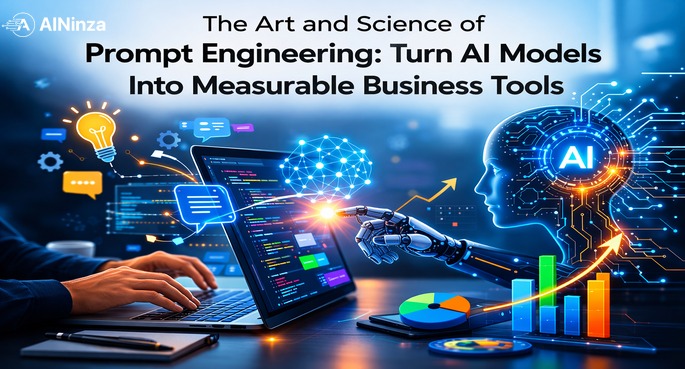
The Art and Science of Prompt Engineering: Turn AI Models Into Measurable Business Tools
Prompt engineering is not creative writing. It is not asking an AI model politely to do your homework. It is the discipline of structuring instructions and context so that an AI model reliably produces outputs that drive measurable business results. A poorly written prompt generates vague, generic, or unusable outputs that waste engineering time and money. A well-engineered prompt takes identical models and produces outputs that are 2–3x more useful, actionable, and aligned with your business logic.
This is not hype. Multiple Fortune 500 companies report 2–3x improvement in AI output quality simply by implementing structured prompting practices. Some teams have reduced their AI infrastructure costs by 35% while simultaneously improving quality through better prompt engineering.
In this guide, we reverse-engineer what separates high-performing prompts from mediocre ones. We’ll cover structure, testing, measurement, iteration frameworks, and scaling prompt engineering as a team capability.
Why Prompt Engineering Matters to Revenue and Operations
According to a 2025 McKinsey study, organizations that invest systematically in prompt engineering see 35–45% higher AI adoption rates and 40% faster time-to-value compared to those that deploy models with default settings. Why? Because models are generic. Your business logic is specific.
A model trained on internet data doesn’t know: Your pricing strategy. Your risk tolerance. Your brand voice. Your customer personas. Your compliance requirements. What outcomes actually matter to you. What failures cost you money.
Prompt engineering is how you encode that specificity into model behavior without retraining or fine-tuning. It’s the fastest path to ROI, and it’s repeatable at scale.
The Anatomy of a High-Performing Prompt: Five Key Components
A structured prompt has five components that separate winners from average performers. Each component addresses a specific failure mode and improves reliability.
1. Role & Context (Persona Definition)
Start by assigning a specific, detailed role. Instead of: “Write a customer email.” Use: “You are an account executive at a B2B SaaS company with 8 years of experience closing deals in the $50K–500K range. Your tone is professional, warm, and direct. You avoid jargon unless it demonstrates product knowledge. Your goal is to move the deal forward without sounding salesy. You have closed 500+ deals and have a 68% win rate.”
This context anchors the model’s behavior to a real role with clear incentives and constraints. Role definition alone can improve output quality by 15–25%. The model now understands not just what to do, but why and from what perspective.
2. Objective & Output Format (Explicit Structure)
Be explicit about what you want. Instead of: “Analyze this customer feedback.” Use: “Analyze the following customer feedback and output a JSON object with three fields: (1) sentiment (positive, neutral, negative), (2) primary issue (max 10 words), (3) recommended next step (one of: escalate, refund, upsell, documentation). Output only the JSON object, no preamble.”
The model now knows: what to analyze, what format to use, and how constrained the output should be. Output format specification eliminates 30–50% of downstream parsing errors and makes integration seamless.
3. Context & Examples (Few-Shot Learning)
Provide 2–3 examples of the behavior you want. For classification, show input + output pairs: Example 1: Input: “Your product crashed my system.” Output: {“sentiment”: “negative”, “primary_issue”: “system crash”, “next_step”: “escalate”}
Example 2: Input: “Works well. Any plans for mobile?” Output: {“sentiment”: “positive”, “primary_issue”: “mobile app request”, “next_step”: “upsell”}
Three examples are usually enough for the model to generalize accurately to new inputs. Few-shot learning improves accuracy by 10–20% compared to zero-shot approaches and is faster than fine-tuning.
4. Constraints & Guardrails (Safety & Boundaries)
Specify what the model should NOT do: “Do not hallucinate product features. Only reference features that exist.” “Do not suggest discounts above 15% without manager approval.” “Do not make promises about timelines without engineering sign-off.” “If the input is ambiguous, ask for clarification rather than guessing.”
Guardrails reduce errors and keep outputs safe. They’re especially critical in high-stakes domains (finance, healthcare, legal). Guardrails also prevent the model from taking shortcuts or making assumptions.
5. Chain-of-Thought (Transparent Reasoning)
For complex tasks, ask the model to show its work: “Before answering, think through the following steps: (1) Identify the customer’s primary pain point. (2) Map it to one of our solutions. (3) Check if we have case studies for that solution. (4) Recommend next steps based on their company size and industry.”
Chain-of-thought increases accuracy by 5–15% on complex tasks and makes errors easier to debug. It also lets you audit the model’s reasoning, which is critical for compliance.
Testing & Iterating Prompts: A Disciplined Process
Prompts should be tested like code. Here is a repeatable process used by high-performing teams.
Step 1: Define Success Metrics Before You Write
Before writing the prompt, define what “good” looks like: Accuracy: % of outputs correct on a held-out test set. Target: ≥90%. Latency: Output generation time. Target: <2 seconds per request. Cost: Token spend per request. Target: <$0.05 per request. Safety: % of outputs that violate guardrails. Target: <1%.
This prevents you from optimizing in the wrong direction and gives you a clear stopping point.
Step 2: Create a Real Test Dataset
Collect 30–50 examples from your actual use case (real customer emails, real feedback, real requests). Label them with the expected output. This is your ground truth. Don’t use generic examples from the internet. Your actual use case is unique.
Step 3: Baseline Your Current Process
Test your current process (manual or existing system) on the same 50 examples. Measure accuracy and time per item. This is your baseline. If your baseline is 70% accuracy and 5 minutes per item, your AI target might be 90%+ accuracy and 30 seconds per item.
Step 4: Write, Test, and Iterate Prompt Versions
Start with Version 1 (basic structure). Run it on your 50 test examples. Measure accuracy, latency, cost. Iterate: If accuracy <85%, add more examples or refine the objective. If accuracy >85% but latency is high, simplify or use a faster model. If cost is high, reduce output verbosity.
Real teams report: Prompt v1 = 72% accuracy. v2 = 81%. v3 = 89%. v4 = 93%. v5 = 94%. Then you stop. Expected iterations: 3–5 versions.
Step 5: A/B Test in Production Before Full Rollout
Once you have a prompt with >90% accuracy on your test set, deploy it to 10% of live traffic. Monitor: Actual accuracy (compare AI output to human review). User satisfaction (if available). False positives and false negatives. After 1 week, compare results to your baseline. If the prompt outperforms, expand to 50%. If it underperforms, analyze failures and iterate.
Prompt Templates for Common Business Tasks
Template 1: Lead Qualification
You are a lead qualification specialist with expertise in B2B SaaS sales. Your role is to score inbound leads on three dimensions: fit, urgency, and budget readiness. Scoring: Fit (1–5): Does the company match our ideal customer profile? Urgency (1–5): How quickly do they need to solve this problem? Budget (1–3): Do they have budget allocated? Output JSON with three scores and one-sentence recommendation (qualify, nurture, disqualify). Only use information provided in the lead data. If budget information is missing, output 1 for budget field.
Template 2: Customer Support Response Drafting
You are a support agent for [PRODUCT]. You have 5 years of experience and are known for being helpful, honest, and professional. Tone: Warm, direct, no corporate jargon. If you don’t know the answer, say so. Always offer next steps. Structure: 1. Acknowledge the customer’s issue (1 sentence). 2. Provide the solution or explanation (2–3 sentences). 3. Offer a follow-up action (1 sentence). 4. End with genuine closing. Only use knowledge from our knowledge base. Do not invent features or timelines.
Template 3: Contract Risk Assessment
You are a contract reviewer. Your job is to identify legal and commercial risks in vendor contracts. Risk Levels: Critical (deal-breaker), High (negotiate), Medium (acceptable with note), Low (standard). For each contract, assess: 1. Liability caps 2. Termination clauses 3. IP ownership 4. Confidentiality obligations 5. Pricing escalation. Output JSON with risk level and recommended negotiation point for each category. Do not skip any category. Do not recommend accepting “as-is” without full assessment.
Measurement: How Prompt Engineering Impacts Business
Track these metrics to quantify prompt engineering ROI:
| Metric | Measurement | Target Improvement |
|---|---|---|
| Accuracy | % correct outputs on blind test set | +15–30% |
| Throughput | Tasks completed per human per day | +40–60% |
| Quality Consistency | Std dev of output quality scores | -30% (less variance) |
| Cost Per Task | Infra + labor cost per completed task | -25–40% |
| Time-to-Insight | Hours from request to decision-ready output | -50–70% |
Real example: A fintech company used prompt engineering to automate compliance review of customer agreements. Before: 45 minutes per contract, 87% accuracy, manual review required. After: 3 minutes per contract, 94% accuracy, 95% require no rework. ROI: $120K saved annually on contract review labor, plus faster close cycles (average close time improved from 32 days to 18 days).
Common Mistakes in Prompt Engineering
Mistake 1: Treating Prompts Like Magic Spells
Adding “please,” “be thoughtful,” or “give your best answer” doesn’t help. Models don’t respond to politeness. They respond to clarity, examples, and constraints. Focus on structure, not tone.
Mistake 2: No Baseline Comparison
Many teams deploy AI without measuring if it’s better than the status quo. Always measure your manual process first. If AI is only 5% better, it’s not worth the complexity.
Mistake 3: Ignoring Output Format Constraints
If you need JSON, ask for JSON explicitly. If you need <500 words, specify that. Without constraints, models generate inconsistent outputs that break downstream systems.
Mistake 4: Testing on Toy Data
Test prompts on real data from your actual use case. Generic examples don’t reflect your specific domain challenges.
Mistake 5: Firing-and-Forgetting
Prompts degrade over time. As your business changes, prompts need updates. Implement a quarterly refresh cycle. Audit 20–30 recent outputs for quality drift.
Scaling Prompt Engineering: From Individual to Team
As you scale, prompts become shared infrastructure.
Week 1–2: Documentation
Create a prompt template library. For each template, include: use case, role, objective, examples, constraints, expected accuracy, and last update date.
Week 3–4: Standards
Establish a prompt review process. Before deploying a new prompt to production, it must pass: (1) human spot-check on 10 test cases, (2) accuracy measurement on held-out test set, (3) cost and latency review, (4) guardrail compliance check.
Month 2+: Versioning
Version your prompts like code. Prompt v1.0, v1.1 (bug fix), v2.0 (major improvement). Log which version is running in production. If v2.0 underperforms, you can roll back to v1.1 with confidence.
FAQ
Do I need to learn how models work to write good prompts?
No. You need to understand your business logic and be disciplined about testing. Model architecture details are less important than clarity, examples, and measurement.
Can I use the same prompt for different models (GPT-4, Claude, etc.)?
Partially. Core structure transfers, but tuning is needed. Spend 10–15% extra time re-testing on your chosen model.
How often should I update prompts?
Quarterly minimum. More frequently if your business, products, or data change. Monthly is ideal for high-stakes use cases (compliance, underwriting, etc.).
Conclusion: From Guessing to Discipline
Prompt engineering is how you turn generic models into business tools. It requires discipline: testing, measurement, iteration, and continuous improvement. Teams that treat prompts as a core capability—not an afterthought—see 2–3x better ROI from AI investments.
Your next step: Pick one business task that is repetitive, rule-based, and currently manual (lead qualification, email drafting, data review). Write a structured prompt using the five-component anatomy. Test it on 30–50 real examples. Measure accuracy vs your current manual process. If it’s >15% better, roll it out to 10% of traffic and monitor.
Key References & External Resources
- McKinsey — The State of AI Report 2026
- Gartner — AI Implementation Failures & Solutions
- Microsoft Work Trend Index
- NIST AI Risk Management Framework
- AWS — Retrieval-Augmented Generation (RAG)
- Google Cloud AI Use Cases & Architecture
- PwC — AI Economic Impact & Enterprise Adoption
- Accenture — AI & Enterprise Transformation
Ready to Implement AI That Actually Delivers ROI?
AINinza is powered by Aeologic Technologies. If your team wants practical AI automation, AI agents, or enterprise AI workflows with measurable business outcomes, book a strategy conversation with Aeologic: https://aeologic.com/.